Fourth Sunday of Lent

In St. John\’s account the blind man does not know who Jesus is until the end of the story. Jesus asks him: \”Do you believe in the Son of Man?\” He answered and said, \”Who is he, sir, that I may believe in him?\” Jesus said to him, \”You have seen him, and the one speaking with you is he.\” He said, \”I do believe, Lord,\” and he worshiped him. 
Since the man was born blind it was unheard of that such a man could see again. So, we do not hear him begging for a cure. Yet, Jesus stopped, \”spat on the ground, made clay with the saliva and smeared the clay on the blind man\’s eyes, saying to him, \’Go, wash in the Pool of Siloam\’.\” He went, washed and came back able to see. By this time Jesus and his disciples had left. So although he could see now, he did not see Jesus. He only knew him by name, that he was a good man who did the impossible: cure a man born blind. To this fact he gives witness to his neighbors, his parents and to the Pharisees that this man was good: \”A sinner could not have opened the eyes of a man born blind,\” he said to them. In the end he was criticized, and expelled from the synagogue. 
When Jesus heard that this man had been thrown out of the synagogue, he sought and found him. At last the man could see Jesus! Jesus said, \”I came into this world for judgment so that those who do not see might see, and those who do see might become blind.\” 
Jesus desires all people to see him and to believe that he is the Son of Man. Some choose to remain spiritually blind although they can see; others choose to see, although, through no fault of their own, they are blind spiritually or physically. Jesus heals those who want his healing. 
This story comes midway through Lent to give us hope and direction: hope in the great mercy of God that He will pour out on us as we reach Holy Week and Easter, and direction to know how to follow Him more closely. God\’s mercy is without end. It reaches to the depths of our being and enables us to see our \”blind spots\” and ask for God\’s healing. 
We grow in our knowledge of Him as we allow ourselves to enter into a closer relationship with Jesus, the Son of God and Son of Man. Like the beggar, then, we too can worship Him as Lord and thank Him for his great mercy to us. 

Third Sunday of Lent

On this Third Sunday of Lent, we encounter three different texts that speak to us of \”living water\”. First, Moses is called to strike a rock so that the thirst of the grumbling Israelites may be quenched. In antiquity the rock in this case is a foreshadowing of the heart of Christ pierced by the lance through which blood and water flow in the final climax of the crucifixion. Jesus\’ body, so mangled by whips and abuse already, pours out His love ever after death. He wishes to give all to the Father even until the last drop. 
St. Paul remarks that Christ died at a point when most of the people in Jerusalem were hostile to Him. However, \”the love of God has been poured out into our hearts\” through the Holy Spirit who has been given to us. We are often like Moses, grumbling, or at least questioning when life gives us a spin we do not understand. How could God do this to me? Doesn\’t He know? Yet, because Christ died \”while we were yet sinners\” His grace beckons to us in the words of the responsorial psalm for Mass, \”If today you hear his voice, harden not your hearts.\” He asks us to open ourselves to the living water, the light of grace, and trust–even though we may not see the way. 
The Samaritan woman at the well is promised this living water. Suddenly, she realizes with whom she is talking. She opens her heart and follows the grace she is being given by God. The Holy Spirit has revealed to her the Messiah and she goes in haste to alert her fellow villagers. 
In summary, let us examine our relationship with God. Have we heard this voice of living water deep in our hearts? Have we been attentive? Let us make it our prayer in this holy season of Lent.

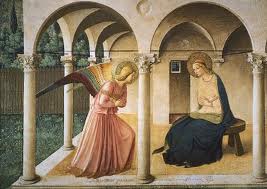
Solemnity of the Annunciation

To celebrate this beautiful feast, we are delighted to give you Sr. Bernadette Marie\’s sermon from yesterday\’s Solemn Chapter:
     The Incarnation of the Word in Mary\’s womb is the precursor to us of the Holy Eucharist. Each day Christ\’s incarnation is repeated at every Mass at the moment of Consecration. St. Augustine wrote, \”O awesome dignity of the priest\’s, in whose hands as in the womb of the Virgin the Son of God becomes incarnate.\” And He becomes incarnate in each one of us when we receive Him in Holy Communion. His love for us is so great that He was not content to be united to the purest of virgins; He desired to be united to each one of us in particular. Who will ever understand God\’s immense love for us! Who can fathom His great humility!
     St. Gregory the Great said, \”Do you wish to know, dearly beloved, the leaps Christ made? He came from heaven into the womb of the Virgin; from the immaculate womb He went to the manger; from the manger He went to the cross; from the cross He went to the tomb.\” We can add one final leap to this, namely, to the Eucharist, because as St. Thomas Aquinas sings in the inspired stanzas of the Adoro Te: \”On the cross only His divinity lay concealed, but here [in the Eucharist] is also hidden His humanity.\”
     Because we have the privilege of receiving Jesus in Holy Communion on a daily basis and because our human nature is weak, there is always the danger of Holy Communion becoming routine, and that we might offer an inadequate reception to the Divine Guest. For this reason, Mary must be our model; for she received Jesus with such love and joy in her heart. Who better than Mary, the highly favored one, whom God chose to unite His divinity to our humanity, can teach us the way to receive Jesus in our body and in our soul. The Mother of God is also our Mother, and like any good mother, she sets the example for her children to follow. Her faith, her humility and her gratitude for God\’s infinite goodness are all virtues to admire and imitate. 
     Mary is also the spouse of the Holy Spirit. Mary said to the angel, \”But how can this come about since I am a virgin?\” The angel answered, \”The Holy Spirit will come upon you, and the power of the Most High will cover you with its shadow.\” St. Bernard says that the Holy Spirit is necessary to us just as He was to Mary, whom He covered with His shadow to protect her virginal body at the approach of the Divinity. 
     Just as the Holy Spirit was present in Mary in conceiving Jesus, in forming the Body of Christ, so also will the Holy Spirit act in us in our Communions. He wants to make of us other Christs. He desires to change us spiritually into Jesus, to make us one being with Him. So that when Jesus ceases to be with us sacramentally, He will still live in us spiritually. In this way the Holy Spirit prolongs our Communion, continuing in us the divine life of Jesus. The Catechism of the Catholic Church states: \”The Holy Spirit prepared Mary by his grace.\” The Holy Spirit will also help us to receive Jesus, like Mary, with a heart full of love and fervor. \”The Spirit helps us in our weakness; for we do not know how to pray as we ought, but the Spirit himself intercedes with sighs too deep for words.\” 
     So as we celebrate this day Christ\’s incarnation in Mary\’s womb, the day \”the Word was made Flesh,\” with a humble heart let us give thanks to God for this \”Sacrament of Love\”, as St. Thomas called it. For with the Eucharist God has given us everything. That is why St. Augustine exclaimed: \”Although God is all-powerful, He is unable to give more; though supremely wise, He knows not how to give more; though vastly rich, He has not more to give.\”

Second Sunday of Lent

     Each Lent the Church encourages us to do three ancient practices: prayer, fasting and almsgiving/charity. 
     Today\’s Gospel, the Transfiguration, focuses us on prayer. The glorification of Jesus before his apostles is meant to strengthen them for his coming Passion and Death. Prayer will also strengthen and calm us in the midst of our own trials and difficulties. This Christ-moment can teach us much about prayer and contemplation. 
     Contemplation is a spiritual, intellectual and emotional experience in which the apostles (and we) can receive insight into the depths of both Jesus\’ humanity and divinity. It is a prayer that is given to us. We do not earn it or make it happen. God takes the initiative and we respond. 
     The Transfiguration presents contemplation as a growing and transformative experience for everyone involved–Christ, Moses and Elijah received greater glory, the disciples greater insight and understanding. We, too, struggle and gradually grow in prayer. The Spirit increases charity in our prayerful hearts. 
     The disciples had a process of training, climbing the mountain, waiting for the manifestation of Christ\’s glory. This Lent is an opportunity for us to grow in our awareness of being active members of the Body of Christ through our greater efforts at prayer.

St. Joseph

The bonds that exist between the heart of Joseph and that of the Child Jesus are–since Jesus is God–of an even more amazing clarity and strength. No child has ever been so united to his father as Jesus is to Joseph; no father has ever been so united to his child as Joseph is to Jesus. Joseph loves Jesus\’ heart–a heart so burning with love, so humble, so poor and so gentle; he loves it with a divine love, which is \”substantial\” and eternal. He is wholly given to Jesus and loves Him with all his heart as a man and as a father, and with all his sensibility, for Joseph loves the sensibility of Jesus\’ heart, which is so close to Mary\’s heart. 

–from The Mystery of Joseph by Fr. Marie-Dominique Philippe, O.P.

First Sunday of Lent

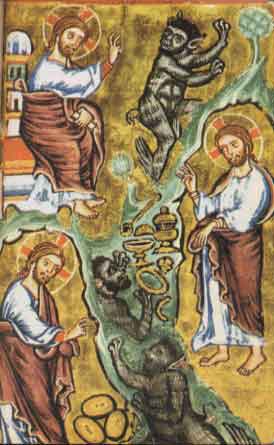
At that time Jesus was led by the Spirit into the desert to be tempted by the devil…
Matthew 4:1

The temptations Jesus faces in Matthew\’s Gospel are temptations to power and control in various guises. In fact, all our temptations seem to come down to this one thing: the desire to make ourselves like God. In union with our first parents, we have a hard time believing that God really forbade us to eat of the tree of the knowledge of good and evil (or whatever other sinful temptation presents itself to us). If we do not keep our gaze fixed on God alone, it\’s easy to be led astray by the apparent goods the devil offers us. But we can hold fast to God\’s Word, as Jesus did, quoting Deuteronomy to the devil in the desert and resisting the temptations to power and control that don\’t really exist. We know the devil can\’t deliver what he promises, so why listen to him? Let\’s keep our hearts open to God during this season of Lent and say with Jesus, \”Get away, Satan! It is written: The Lord, your God, shall you worship and him alone shall you serve.\” (Matthew 4:10)