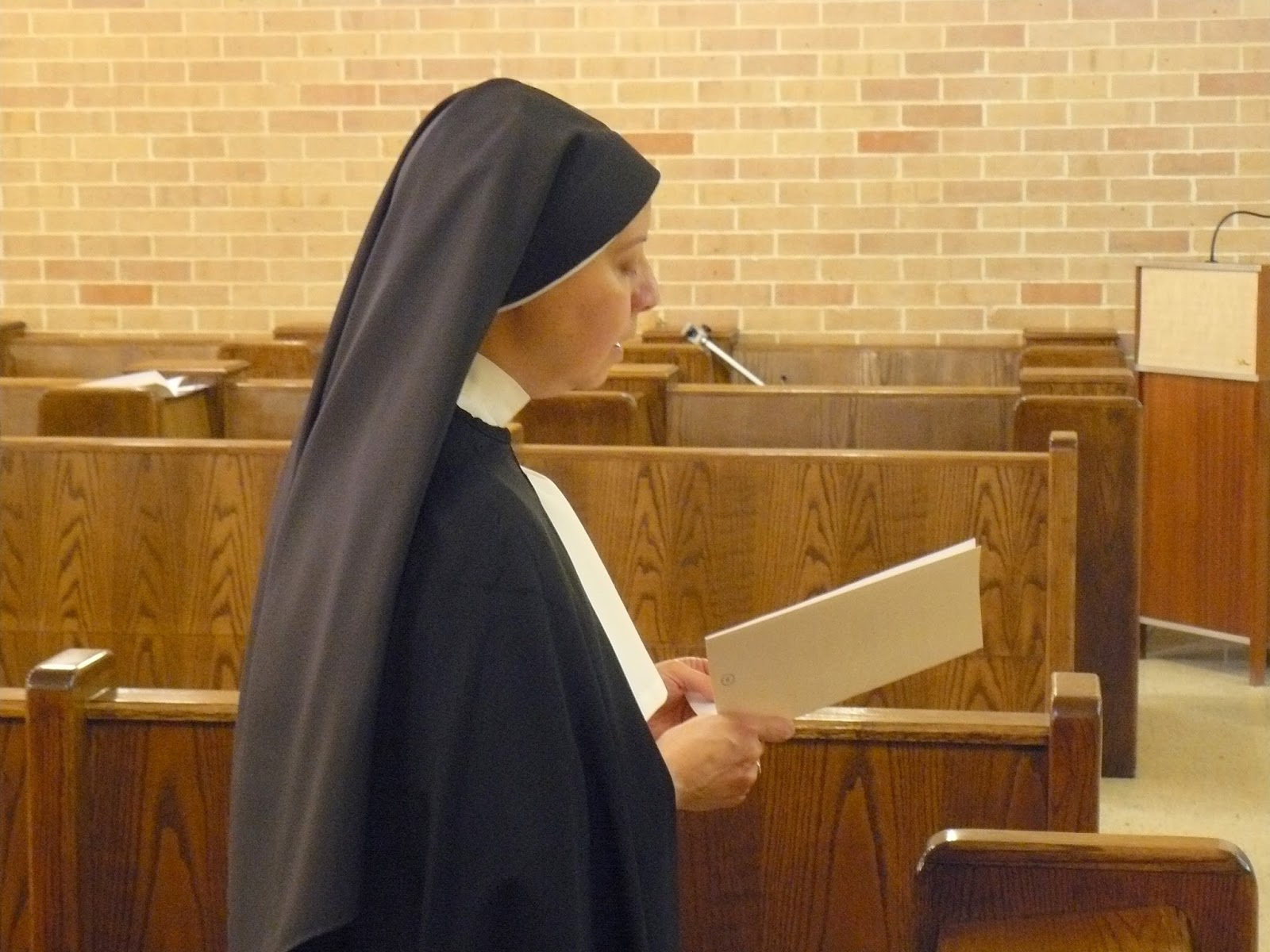
These two radiant women are now in retreat, awaiting their respective great days! Cloe (our postulant on the right) went into retreat on the 19th, and she will come out of the desert on the 28th, to be clothed in radiant white as a novice with a new name. What will it be?? And Sr. Bernadette Marie (on the left) enters retreat this evening, emerging on the 30th to make her solemn profession. Pleas e keep our two sisters in your prayers as they seek the guidance of the Holy Spirit and prepare to make these important steps in their religious lives!
Wood Carving and Icon Workshop
You may be wondering, \”What have the nuns been up to since the beginning of the year?\” Well, it\’s been kind busy, what with preparing for a clothing and a solemn profession! In the midst of all these fun activities, we also just concluded a wood carving and icon workshop with Sr. Mary Magdalen, OP, artist extraordinaire from Queen of Peace Monastery in Squamish, British Columbia, Canada (about two hours from Vancouver). Sister has come before several years ago (back in 2001!!) and given wood carving lessons, and she also came to design and carve the front of our tabernacle a few years ago ( maybe 2008 or 2009?). But we realize now that our first carvings were mere beginnings compared to what she helped us to accomplish this time!
The room we transformed into a temporary workshop…
Sr. Mary Christine soon proved to be an expert at wood carving!
Hard at work! You can see Sr. Mary Magdalen sitting down at the far left. Sr. Mary Jeremiah is working beside her, and then Sr. Mary Rose, Cloe, and Sr. Mary Christine.
Sr. Mary Jeremiah works on her Holy Spirit carving
Sanding the edges is an essential part of finishing, as Sr. Mary Giuse knows
Sr. Mary Rose with her lovely carving.
Sr. Irma with her Dominican Jubilee carving! Hers is the only carving that got a touch of color. The rest were simply treated with clear varnish.
We also learned how to make icons by mounting pictures or posters to pieces of wood. Very interesting work and the results are great! Cloe and Sr. Mary Jeremiah are trimming a large picture which they will mount.
Cloe touches up a picture of St. Catherine of Siena
Sr. Irma with an icon of the Holy Family
We had such a wonderful time learning with Sr. Mary Magdalen, and we are so grateful to her community for allowing Sister to spend so much time with us! Hopefully she can return some time and teach us more! Meanwhile, some of the sisters here hope to set up a wood carving and icon mounting workshop in one of our old barns. Who knows where this will lead? More details to follow!
Christmas Reflection Alert!
Our Sr. Mary Jeremiah has a beautiful reflection on the Southern Dominican Province website! We encourage you to read it here.
Blessed New Year to All!
We wish you all a happy and blessed year 2016! May holy Mary, the Mother of God, be your guide and help as we make our way through this year dedicated to mercy and to the 800th anniversary of the Order of Preachers. Know that we are praying for you during this year of grace, and we hope you will keep us in your prayers as well.
Hopefully we will have some Christmas photos up soon! It\’s been very busy around here!
Merry Christmas 2015!
The Virgin today brings into the world the Eternal
And the earth offers a cave to the Inaccessible.
The angels and shepherds praise Him
And the Magi advance with the star,
For You are born for us,
Little Child, God eternal!
–Romanos the Melodist
Blessed and joyful Christmas to all! We remember you in our prayers!
Solemn Chapter Sermon for Christmas
This year our postulant Cloe gave the sermon. It\’s very lovely and so we decided to post the entire thing!
2000 years ago, on an ordinary night in an ordinary place, something truly extraordinary happened. In a normal field, shepherds were tending their flocks. They were normal men, ordinary Jews, and like all Jews they were awaiting the coming of the Savior. But they were simple shepherds, not priests or rabbis, and probably didn\’t give the coming of the Messiah much thought. But when they did think about it, they probably expected him to be a savior like the ones the Jewish people had had before: a great leader like Moses, a great king like David, a great prophet like Isaiah.
And then one night the unexpected happened. An angel of the Lord, surrounded by the glory of God, appeared to the shepherds, and they were understandably afraid. But the angel told them, \”Do not be afraid; for behold, I proclaim to you good news of great joy that will be for all the people.\” The shepherds were surprised by this announcement: what was this good news that an angel was proclaiming to them, simple peasants? Then came the news all Israel had been waiting for: a Savior has been born, one who is both Messiah and God.
The surprised shepherds wanted to know where and how they could find this Savior. And then came the most surprising news of all: \”you will find an infant wrapped in swaddling clothes and lying in a manger\”. We\’re so used to the nativity story that it\’s hard for us to realize how completely unexpected and astonishing this proclamation was. The people of Israel were expecting a Savior who was a great, strong leader, and instead God came as a vulnerable little baby. They were expecting someone from a great family with lots of material wealth and prestige, and instead God was born to a poor, simple couple. They were expecting someone with great political power, confronting their Roman oppressors in Jerusalem, but instead the Messiah was born in the small town of Bethlehem and visited by peasants and Gentiles. But as Pope Francis wrote, \”Let us allow God to surprise us. He never tires of casting open the doors of His heart.\” (MV 25)
In this jubilee year of mercy, it is fitting to look at the surprising nature of the nativity story as an act of God\’s mercy. Of course, the whole of salvation history is an act of mercy. God prepared the way with prophets and leaders who taught His people how to stay close to Him. And the Incarnation was the supreme act of mercy, God becoming human to save humanity. His coming was specially prepared with Mary\’s immaculate conception, then began with the annunciation, then Jesus\’ birth, His earthly ministry, culminating in His salvific passion and resurrection. But Jesus\’ birth was a particular act of mercy, not just that He came but how He came, and reveals how God is a God of mercy. As the great apostle of mercy, St. Faustina, said, \”The greatest attribute [of God] is love and mercy. It unites the creature with the Creator.\” And in Misericordiae Vultus, Pope Francis writes that mercy is \”the ultimate and supreme act by which God comes to meet us.\” (MV 2)
God\’s mercy is revealed in how He came to meet us, in the incarnation as a little baby. He didn\’t come as a powerful warrior or political figure, but as a vulnerable infant who needed other people to take care of Him. In His mercy, God humbled Himself to take on our human nature in order to redeem it. It might have been easier for Him to come as a strong adult, but He knew that, ultimately, it would be easier for us to accept Him as Savior if He came as a baby. There is something intrinsically appealing about a baby. Because they are so cute and vulnerable, we feel comfortable approaching them. It\’s easy to imagine meeting the baby Jesus, wrapped in swaddling clothes like any other normal newborn. We are drawn to Him in His vulnerability, and more easily accept Him in His helplessness and littleness. His vulnerability requires others to take care of Him, and shows that God\’s mercy allow us to work with Him in salvation.
There was also great mercy in the Savior choosing to be born into a poor family. He could have chosen a family of great wealth and power, but instead He chose Mary and Joseph, poor peasants from the small town of Nazareth. In His humility, God knew that the Savior needed to be someone everyone could relate to, a simple and approachable man, so in mercy He chose to be born to simple, approachable people. Jesus, both as a baby and as a grown man, presented Himself as a normal person whom everyone felt comfortable coming to. From the shepherds in the field to the lepers who needed His healing to the sinful who needed His forgiveness, Jesus welcomed everyone regardless of status. Even today, I think most of us picture Jesus either as a normal baby in a blanket or as a simple carpenter in peasant robes, which makes Him much more approachable to us in prayer than if we had to picture Him as a powerful king or cryptic prophet.
God also showed His mercy by revealing Himself as a baby to a variety of people. He could have hidden Himself away for decades until He was ready to begin His ministry, but instead He sent angels to announce the birth to the shepherds and sent signs so that even the foreign magi would know of the Savior\’s birth. This revelation of His birth showed that His mercy and salvation is for everyone, including Gentiles. Previous prophets and kings had been just for the chosen people, but in Jesus, the ultimate Savior, God finally sends salvation for everyone. God\’s mercy is overflowing generosity, embracing everyone with His love and forgiveness.
Pope Francis called this jubilee year of mercy because, as he wrote, \”at times, we are called to gaze even more attentively on mercy so that we may become a more effective sign of the Father\’s action in our lives.\” (MV 3) So this Christmas, let\’s contemplate how the nativity story shows God\’s mercy so that we can learn how God wants us to be merciful to each other. By God becoming incarnate as a vulnerable baby to a poor family, He made Himself much more approachable to us, those whom He came to save and serve; just so, we must do what we can to make ourselves approachable to those we wish to serve in mercy. Jesus\’ birth was first revealed to peasants and Gentiles, not the Jewish elite, showing that God\’s mercy extends to all, not just those who may seem most worthy of it. In imitation, we must show mercy and care to everyone, not just those we are comfortable with helping or think deserve it.
At Jesus\’ birth, the angels sang, \”Glory to God in the highest, and on earth peace to people on those whom His favor rests.\” God\’s favor and mercy rest on everyone, so Christmas especially is a time for all of us to come together to reflect on the peace and mercy God has for us in our treatment of one another.
The Four Last Things: Heaven
The Catechism of the Catholic Church describes heaven as \”eternal life with God; communion of life and love with the Trinity and all the blessed. Heaven is the state of supreme and definitive happiness, the goal of the deepest longings of humanity.\” (1023) As we see in the picture above, Fra Aneglico, OP pictured Heaven as a beautiful garden where saints and angels join in an eternal dance of joy. St. Ambrose wrote, \”For life is to be with Christ; where Christ is, there is life, there is the kingdom.\” This mystery is beyond our limited human understanding. There was a cartoon many years ago that depicted a man–wearing wings and a halo–sitting on a cloud, presumably in Heaven, and thinking wistfully, \”Wish I\’d brought a magazine…\” This idea that Heaven is a place of static, boring perfection is entirely wrong. Heaven is something that, as the band MercyMe sang, we can \”only imagine\”.
In meditating on Heaven, some of us may also think of music, and a piece that came to mind was Olivier Messiaen\’s composition \”Quatuor pour la fin du temps\” (Quartet for the end of time). This work was composed in 1940 while Messiaen was in a prison camp. Friendly guards gave him paper, pencils, and erasers, and allowed him a place to write. He composed the quartet using the instruments available in the camp: violin, clarinet, cello and piano. The result is a remarkable and deeply moving meditation on the end of time and eternity itself. Messiaen used a phrase from Revelation 10:7 to inspire him–in his Vulgate translation the angel says, \”There shall be no more time\”, although today we are more accustomed to the translation which reads, \”There shall be no more delay\”. The piece was actually performed in the camp in January 1941 before a large audience of prisoners and guards. What does this have to do with Heaven? Well, for one thing, there is no time in Heaven. Heaven is a perpetual and eternally present Now. Time with its sadness has come to an end; the joy of Heaven goes on always. Messiaen\’s composition, especially the two movements in praise of Jesus (5 and 8) attempt to suggest this beautiful sense of peace and everlasting happiness. It is also a reminder that even in the most dire of circumstances, we can lift our eyes to God and trust that in His great mercy He will bring us to be with Him forever one day. Messiaen\’s response to the cold, hunger and deprivation of the prison camp was to compose a masterpiece using what he had available to him. His Catholic faith sustained and encouraged him throughout his ordeal.
St. Catherine of Siena, OP once said, \”All the way to heaven is heaven.\” When we remember that Heaven is our longed-for, most desired destiny, we will not mind the little irritations and the enormous problems that confront us each day. We will hopefully keep our eyes fixed on Christ and remember that in Him alone we find our true happiness and joy.