Going Bananas

It\’s often said, \”When life hands you lemons, make lemonade.\” But what do you do when life hands you bananas?
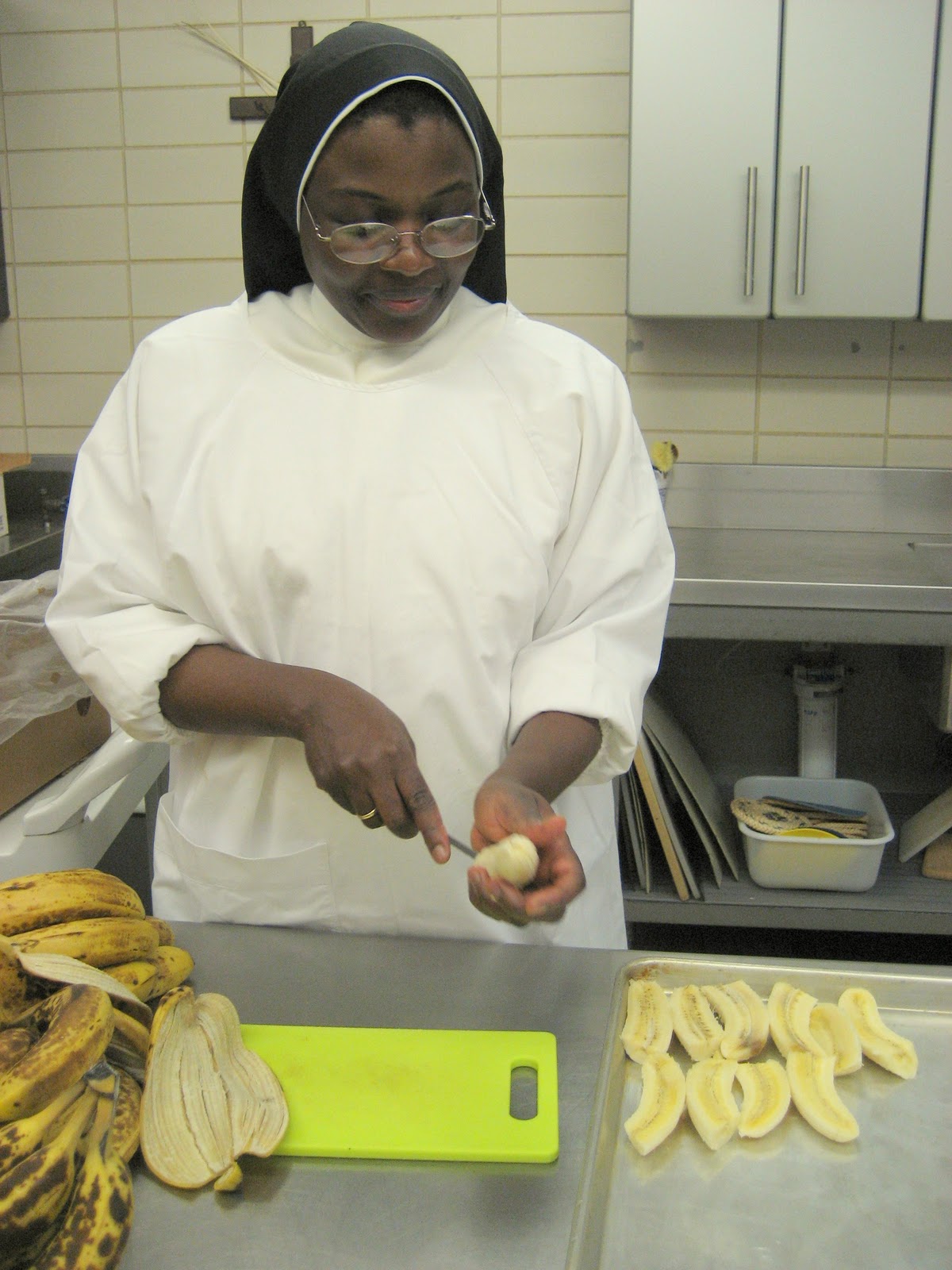
We recently received several cases of bananas from a generous benefactor–and then we received still another case from ANOTHER generous benefactor! We all like bananas, but there\’s only so many you can eat before they start to get mushy…so, what to do? Fortunately our head cook, Sr. Marie Augustine, is an expert on bananas. Whenever we receive large quantities of bananas, we dry them! It\’s easy to do, healthier than banana bread or muffins, and the sisters love them. 
First, of course, you peel the bananas!
Then you slice them, first across the width, then in half down the middle of the banana, so you have four pieces, as you can see here!
Be sure to place the bananas seed side up–they get very sticky on the bottom otherwise. We dry our bananas on baking sheets on top of the stove. It usually takes a few days. You can probably do it faster with a drying machine but we prefer this method because we can do a lot of bananas at once. 
Dried bananas are naturally sweet, and make a great addition to breakfast! When we started drying bananas, we learned that not only our African sisters (like Sr. Marie Augustine, who is from Tanzania), but also our Vietnamese sisters were familiar with dried bananas and liked them. We are fortunate to have a wide mixture of cultures and backgrounds in our community, and we welcome any more that would like to join us! In the meantime, we\’re enjoying our bananas–and we\’re so grateful to ALL our benefactors who make our life possible!

The Holy Name of Mary

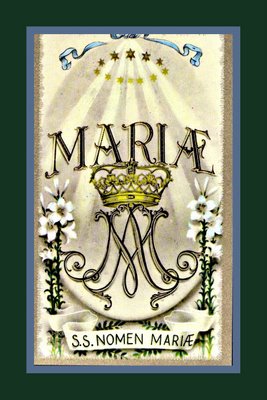
 \”Blessed be the name of Mary, virgin and mother…\” (from the Divine Praises)

St. Bernard of Clairvaux once wrote, \”In danger, in difficulties, in doubts, think of Mary. Call upon Mary! Never let her name be absent from your lips or absent from your heart.\” As Dominican nuns, we each take a form of this name as part of our religious name. It can be Mary, as in Sr. Mary Agnes; or Marie, as in Sr. Marie Augustine; or Maria, as in Sr. Maria Rosario, or even Miriam, as in Sr. Miriam. The possibilities are numerous, but the intention is the same: to honor Mary and her holy name. May we all have renewed respect for the names of Jesus and Mary today and every day!

Armchair Pilgrimage to the Lands of Dominic

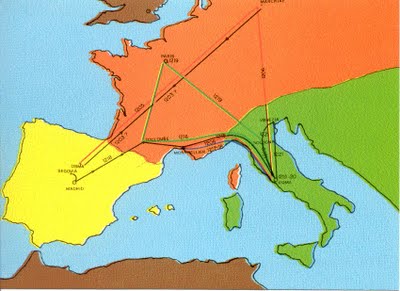
April, says Chaucer, is the month to go on pilgrimage, but for Dominican cloistered nuns, any time is a good time! From September 7-10, we enjoyed a unique pilgrimage–taken without ever leaving home. Our guides were Sr. Ann Willits, OP and Fr. Matt Walsh, OP and our destination was Europe–specifically, the lands where Dominic lived, went around preaching the Gospel, and eventually died.

St. Dominic began his life and journeys in Spain, but traveled as far as northern Germany and into France and Italy over the course of his lifetime.

Our pilgrimage with Sr. Ann and Fr. Matt was in many ways a journey into the heart of Dominican life, as we explored not only the physical world of St. Dominic through slides and lectures but also the interior world of St. Dominic through reflections on many aspects of Dominican life. Sr. Ann\’s thought-provoking lectures and Fr. Matt\’s wonderful homilies and talks gave us much to contemplate! We are so grateful to them for their insights and for giving us a renewed sense of belonging to the Dominican family.

Nativity of the Blessed Virgin Mary

\”Our Lady is the culmination of that long process of selection, of choosing here and rejecting there a human instrument suited to his purpose. which is so characteristic of God\’s dealings with his ancient people…God\’s grace and man\’s free will corresponding with it–that ancient mystery is illustrated at every turn of the Old Testament story, until at last we turn over the page into the New Testament and find its ideal illustration in the life of our Lady herself…She is the culmination of all that process; for in her human nature reached to its highest dignity, to greet the divine condescension of the Incarnate. In her, as nowhere else, God had found the human instrument suited to his purpose; the worthy receptacle of a grace that had not dwelt on earth since Adam lost his paradise. The work of selection is consummated; mankind stands ready for its Redeemer.\” –Msgr. Ronald Knox

Today we celebrate the birthday of the Virgin Mary. We don\’t know a whole lot about Mary\’s birth or childhood because these things aren\’t mentioned in the Gospels–but there are a lot of apocryphal stories about her floating around, which is where we get the names of her parents, Joachim and Anne, for example. Still, we are happy today to celebrate our Blessed Mother\’s birthday! As Fr. Peter John Cameron, O.P. writes, \”Mary\’s is a birthday to remember because the answer to our sorrow, misery, malice, loneliness, inability, and strife is to be born of Mary.\” Happy birthday, dear Mary!

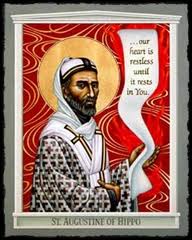
Saint Augustine

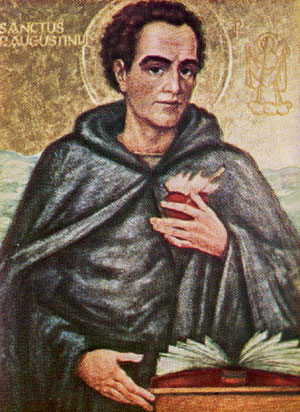
It\’s Sunday, so we are not observing the feast of St. Augustine of Hippo liturgically today as we usually do, but we do want to remember him in a special way.

One of the questions frequently asked by women inquiring about our life is, \”What rule do you follow?\” Dominican nuns, like the friars, follow the Rule of St. Augustine. In 1215, Dominic traveled to Rome to meet with Pope Innocent III concerning the foundation of a new order dedicated to preaching. The Pope was interested, but asked St. Dominic to choose an existing rule for his order (instead of writing his own). For Dominic, this was easy. He had spent most of his life following the Rule of St. Augustine as a canon of the diocese of Osma in Spain. The Dominican Order with the Rule of St. Augustine were confirmed by Pope Honorius III on December 22, 1216. A portion of this rule is read aloud at the beginning of the noon meal in our monastery. After a few years of hearing these pieces of the rule, you practically have it memorized! And it\’s an excellent text to keep close to your heart:
  • \”Let all of you then live together in oneness of mind and heart, mutually honoring God in yourselves, whose temples you have become.\” (n.9)
  • \”Charity, as it is written, \’is not self-seeking,\’ meaning that it places the common good before its own, not its own before the common good. So whenever you show greater concern for the common good than for your own, you may know that you are growing in charity. Thus, let the abiding virtue of charity prevail in all things…\” (n.31)
  • \”The Lord grant that you may observe all these precepts in a spirit of charity as lovers of spiritual beauty, giving forth the good odor of Christ in the holiness of your lives; not as slaves living under the law but as women living in freedom under grace.\” (n.48)
\”Lift up your hearts to heaven! You ask: How can I do it? What ropes are needed? What machinery, what ladders? The steps are your affections, your will is the way. You ascend by loving, by neglect you descend. If you love God you are in heaven while standing upon the earth, for the heart is not raised as the body is raised. When the body is raised it changes its place: when the heart is raised it changes its desire.\”–St. Augustine, Exposition on the Psalms 85.6

Welcome, Father Paul Philibert OP!

Fr. Paul Philibert, OP is our new chaplain here at the monastery. He\’s been in residence since the last part of June–we\’ve been meaning to mention his arrival and welcome presence for some time!

Fr. Paul is a native of Baltimore, MD. He was ordained in 1963, and has spent most of his ministry as a teacher of theology. In keeping with this tradition, he has been teaching some classes in the novitiate.  He is a writer and has recently published translations of works by Cardinal Yves Congar, OP. If all that were not enough, he is also an excellent musician and a gifted preacher. We are delighted to have you as our chaplain, Fr. Paul!

The Patron Saint of Texas

Most of us think of Franciscan saints, like St. Anthony of Padua (San Antonio) when we think of Texas–after all, the Franciscans were a big part of Texas history. But lest we forget–the battle which concluded the war for independence that Texas fought with Mexico took place near the river named San Jacinto–and that is Spanish for Saint Hyacinth, or Jacek, as he is known in his native Poland. A Dominican saint!

St. Hyacinth brought the Dominican Order to Poland and eastern Europe in the 13th century. One day when the Tartars were attacking, he removed the Blessed Sacrament from the church to prevent it from being desecrated. As he was doing this, he heard the statue of the Blessed Virgin Mary speak to him, asking Hyacinth to take her along, as well. Although the statue was very heavy, Hyacinth was able to carry both the statue and the monstrance to safety, which is why he is usually portrayed holding these two items.

It\’s possible that this river near where the battle of San Jacinto was fought–and which gives the battle its name–was discovered on or around St. Hyacinth\’s feast day, August 17–this is how some places in Texas got their names (think of the city of Corpus Christi). Anyway, the battle of San Jacinto (fought on April 21, 1836) was of enormous importance not only to the state of Texas but to all of what we now call the United States. As the inscription on the San Jacinto Monument reads: 
\”Measured by its results, San Jacinto was one of the decisive battles of the world. The freedom of Texas from Mexico won here led to annexation and to the Mexican War, resulting in the acquisition by the United States of the States of Texas, New Mexico, Arizona, Nevada, California, Utah, and parts of Colorado, Wyoming, Kansas and Oklahoma. Almost one-third of the present area of the American nation, nearly a million square miles of territory, changed sovereignty.\”

 The Battle of San Jacinto

Check out our post on Texas history from a Catholic point of view here.