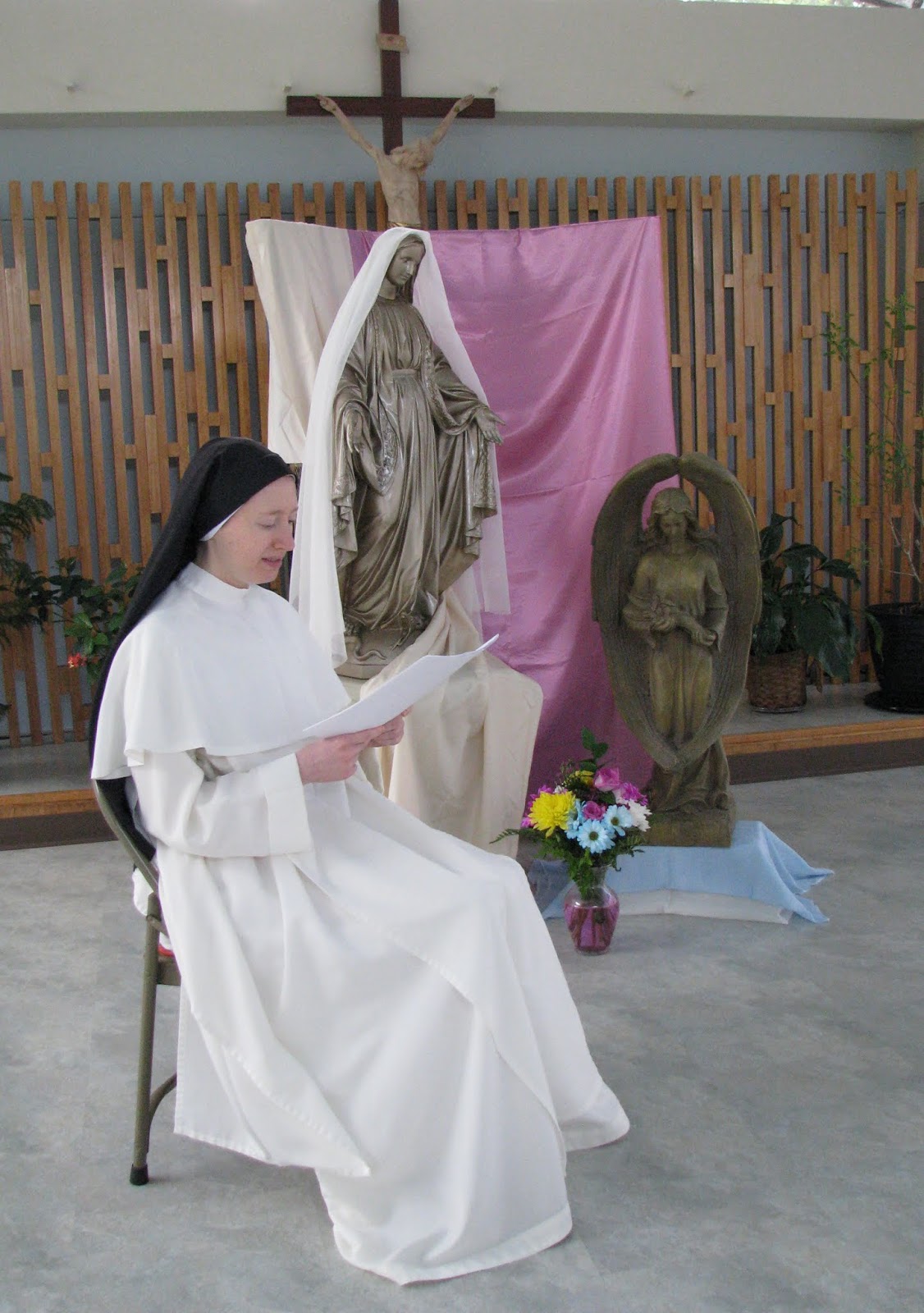
Today is the Solemnity of the Annunciation. There is an ancient monastic custom of having solemn meeting in honor of the two great feasts of the Incarnation — Annunciation and Christmas. This year our sermon was given by Sister Mary Therese. she has recently moved to live and work with the Solemnly Professed nuns as another step in her monastic journey. Sister spoke of the pivitol moment of the Annunciation by the angel Gabriel when Mary said, “Yes”.
Category: Uncategorized
3rd Sunday of Lent 2019
2nd Sunday of Lent 2019
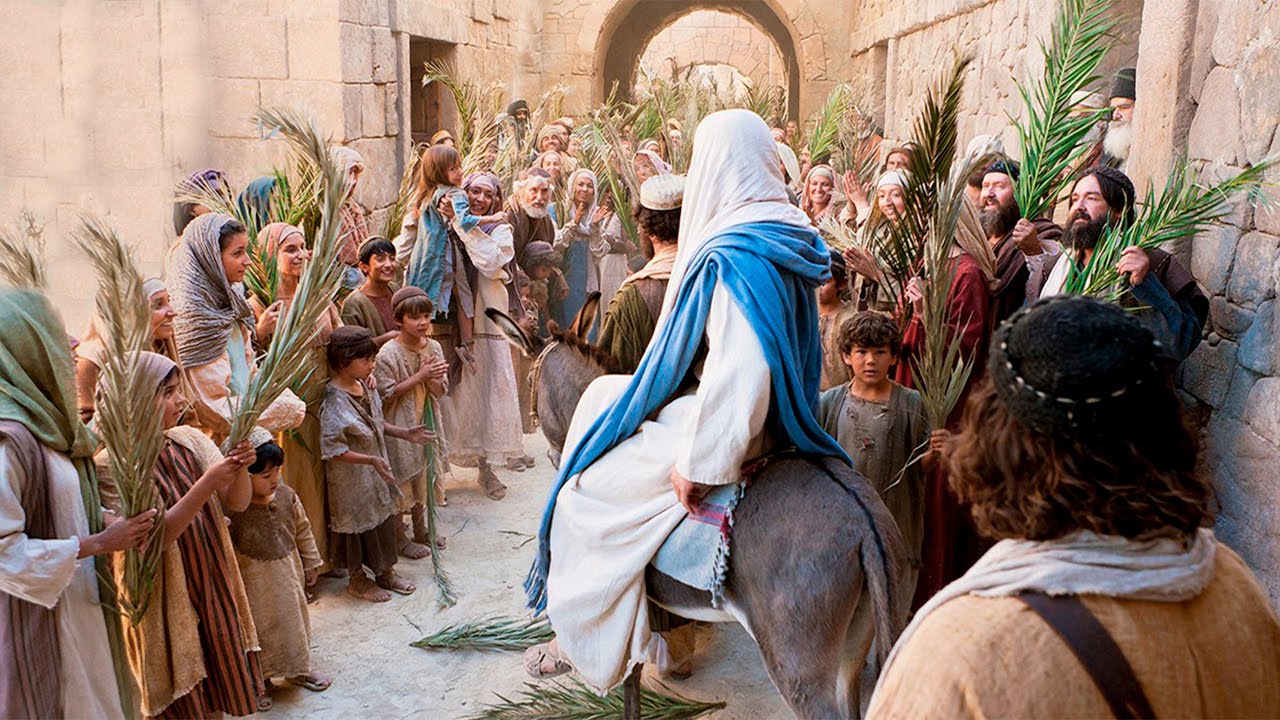
I answer that, Christ wished to be transfigured in order to show men His glory, and to arouse them to desire it. Now men are brought to the glory of eternal beatitude by Christ—not only those who lived after Him, but also those who preceded Him; therefore, when He was approaching His Passion, both “the multitude that followed” and those “that went before, cried saying: ‘Hosanna,'” as related Mt. 21:9, beseeching Him, as it were, to save them. Consequently it was fitting that witnesses should be present from among those who preceded Him—namely, Moses and Elias—and from those who followed after Him—namely, Peter, James, and John—that “in the mouth of two or three witnesses” this word might stand.
By His transfiguration Christ manifested to His disciples the glory of His body, which belongs to men only. It was therefore fitting that He should choose men and not angels as witnesses.
St. Jerome says, on Mt. 17:3: “Observe that when the Scribes and Pharisees asked for a sign from heaven, He refused to give one; whereas here in order to increase the apostles\’ faith, He gives a sign from heaven, Elijah coming down from where he had ascended, and Moses arising from the nether world.” This is not to be understood as though the soul of Moses was reunited to his body, but that his soul appeared through an assumed body, just as the angels do. But Elijah appeared in his own body, not that he was brought down from the empyrean heaven, but from some place on high where he was taken up in the fiery chariot.
St. John Chrysostom says, on Mt. 17:3: “Moses and Elijah are brought forward for many reasons.” 1st, “because the multitude said He was Elijah or Jeremiah or one of the prophets, He brings the leaders of the prophets with Him; that hereby at least they might see the difference between the servants and their Lord.” 2nd, ” … that Moses gave the Law … while Elijah … was jealous for the glory of God.” Therefore by appearing together with Christ, they show how falsely the Jews “accused Him of transgressing the Law, and of blasphemously appropriating to Himself the glory of God.” 3rd, “to show that He has the power of death and life, and that He is the judge of the dead and the living; by bringing with Him Moses who had died, and Elias who still lived.” 4th, because, as Luke says (9:31), “they spoke” with Him “of His passage that He should accomplish in Jerusalem,” i.e. of His Passion and death. Therefore, “in order to strengthen the hearts of His disciples with a view to this,” He sets before them those who had exposed themselves to death for God\’s sake: since Moses braved death in opposing Pharaoh, and Elijah in opposing Ahab. 5th, that “He wished His disciples to imitate the meekness of Moses and the zeal of Elijah.” St. Hilary of Poitier adds a 6th reason—namely, to signify that He had been foretold by the Law, which Moses gave them, and by the prophets, of whom Elijah was the principal.
Lofty mysteries should not be immediately explained to everyone, but should be handed down through superiors to others in their proper turn. Consequently, as Chrysostom says (on Mt. 17:3), “He took these three as being superior to the rest.” For “Peter excelled in the love” he bore to Christ and in the power bestowed on him; John in the privilege of Christ’s love for him on account of his virginity, and, again, on account of his being privileged to be an Evangelist; James on account of the privilege of martyrdom. Nevertheless He did not wish them to tell others what they had seen before His Resurrection; “lest,” as Jerome says on Mt. 17:19, “such a wonderful thing should seem incredible to them; and lest, after hearing of so great glory, they should be scandalized at the Cross” that followed; or, again, “lest [the Cross] should be entirely hindered by the people” [*Bede, Hom. xviii; cf. Catena Aurea]; and “in order that they might then be witnesses of spiritual things when they should be filled with the Holy Ghost” [*Hilary, in Matth. xvii].
Knights of Columbus kick off Air Conditioning/Heating Campaign
The Council of Knights here in Lufkin have been so helpful and wonderful to us for almost 40 years!!!
It can also be found in our Lufkin Daily News for Sunday, March 10, 2019.
We are in the process of replacing our Air Conditioning and heating units in our professed dormitory and novitiate. The AC is something absolutely necessary in the Texas sweltering summers which can run from May to October.
1st Sunday of Lent – 2019
Today we have another outline for our reflection from St. Thomas Aquinas. He speaks about fasting from today\’s Gospel – Luke 4:1-13. It is the account of Jesus praying and fasting for 40 days and nights in the desert, then the devil comes to tempt Him, but Jesus vanquishes him.
St. Augustine says that it is the highest religion to imitate what we worship, so when Our Lord fasted, we ought to imitate Him in fasting. St. Thomas says there are 4 reasons that should move us to fasting:
I. God commands it.
A. God commands it in Genesis 2:15-17, when he told Adam not to eat the fruit of a certain tree.
B. God commands it in the Law of Moses: Lev. 16:31, “It is a sabbath of complete rest to you, and you shall fast; it is a statute forever.”
C. God commands it by the Prophets: Joel 2:14, “Sanctify a fast”
D. God commands it by the Apostles: 2 Cor 11:27b, St. Paul wrote of his many trials, including, “I have been hungry and thirsty, often without food.”
II. The example of Jesus and His teaching that there are 4 things necessary in fasting.
A. We should be cleansed of sin: Matthew 6:17, “When you fast, put oil on your head and wash your face.”
B. We should conceal our fasting from the praise of others: Matthew 6:16, “When you fast, do not … show others that you are fasting.”
C. We should fast with long-suffering and perseverance: St. Augustine wrote in his Rule, “Subdue your flesh with abstinence from meat and drink, as far as your health will permit.”
D. We should overcome the temptations of the devil: “Get behind me, Satan.”
III. The 4 harms that befall those who do not fast when they should.
A. The evil of iniquity, Ezekiel 16:49, ” This was the guilt of your sister Sodom: she and her daughters had pride, excess of food…”
B. The evil of loss, especially, of eternal life, Genesis 3:23, “The Lord God sent him forth from the garden of Eden…”
C. The evil of present punishment: Sirach 37:31, “Many have died of gluttony…”
IV. A 4-fold profit flows from fasting. St. Gregory the Great says,
A. The mortification of vices.
B. An elevation of the mind towards God.
C. The acquisition of virtue.
D. The reward of eternal blessedness.
St. Thomas Aquinas on Lent
We do not have the text of St. Thomas’ homilies; however, we do have some outlines. Here is one that helps us in our Lenten journey. Thomas, and most preachers in the Middle Ages, always used Scripture passages to back up what they were saying. Reading and thinking about just one sentence below can lead us to many insights. He is preaching on Luke 18:35: “A certain blind man sat by the wayside.”
In the moral sense: the blind man is understood as a sinner – “They shall walk like blind men, because they have sinned against the Lord.” Zephaniah 1:17 As the blind does not see bodily, so the sinner does not see spiritually.
1 – There are 7 causes that hinder the blind, which represent the 7 deadly, or capital, sins which produce spiritual blindness.
– A swollen face is like pride: St. Augustine said, “My face is swollen so greatly, that it does not allow me to see.”
– A darkness in the air is like envy: the envious are spoken of as blind, “Their own malice blinded them.” Wisdom 2:21
– A derangement of the eyes is like anger: “My eye is consumed with grief.” Psalm 31:9
– Dust or anything that falls into the eye is like avarice: St. Augustine said, dust is like temporal things, “I wandered after temporal things and I was blinded.”
– No one can see who closes his eyes, this is a weakening from slothfulness: which is not opening one’s intellectual eyes to behold spiritual good. Boethius says, “The wicked accustom their eyes to darkness, they turn away from the light of truth.”
– Too much fluids around the eyes is like gluttony: “Who has redness of eyes? Those who linger long at the wine.” Proverbs 23:29 Too much alcohol deadens the spiritual and bodily eyes.
– Little spots before the eyes is like lust: St. Augustine wrote, “Small cloudy spots … and they darkened my heart that the sincerity of love could not be distinguished from the darkness of lust.”
2 – There are 7 things that produce mental illumination. Spiritual sight consists also of 7 graces.
– Faith – “Receive your sight: your faith has saved you.” Luke 18:42
– Humility – “For judgment I came into the world, that those who see might not see.” John 9:39
– Trials – “Gall of the fish is good for anointing the eyes.” Tobit 6:9
– Love of neighbor – “Eye ointment that you may see.” Revelation 10:18
– Abundant tears – “He went his way and washed and saw.” John 9:7
– Fervent prayer – “They cried out, \’Have mercy on us, Son of David… Jesus had compassion on them, touched their eyes, and immediately their eyes received sight.” John 9:10
– Reverent hearing or reading of Holy Scripture: “On that day shall the deaf hear the words of the Book, and the eyes of the blind shall see.\ Isaiah 29:18
Ash Wednesday 2019
Today is Ash Wednesday, the beginning of Lent, a time of penance, reparation for our sins and participation in the Paschal Mystery (life, suffering, death, resurrection) of Jesus Christ, our Lord and Savior.
It is a graced time when our Faith becomes very Incarnational – tangible, physical. It is a time when we put into special practice the three great acts of religion going back 3,000 years in our Judeo-Christian Faith tradition. Those acts are —
Unfortunately, many people today have walked away from this rich experience of community. Perhaps you might invite a friend or family member to join you for one of the special Lenten Masses, Stations of the Cross, or other activities at your Church. Without faith, people become lost and isolated. This is an anointed time in which Catholics, and all believers in Jesus Christ, around the world make an extra effort to open themselves to God and to grow in His Spirit and His Grace.