5th Sunday of Lent 2019

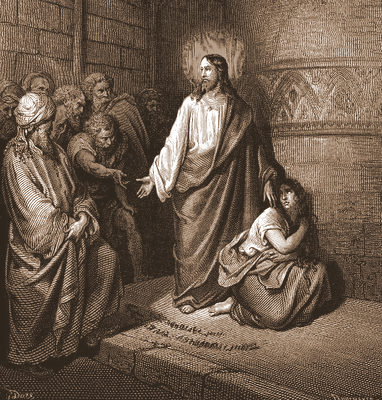
Today’s Gospel is from the Gospel of John 8 and the story of the woman caught in adultery. St. Thomas Aquinas had quite a number of insights on this famous passage in his Commentary of John. We will share some of his thoughts here, but if you would like to read more, click HERE.

JUSTICE and MERCY
1125 The Evangelist shows them proceeding with their test.
      First, they point out the woman\’s fault;
     secondly, they state the justice of the case according to the Law;
     thirdly, they ask him for his verdict.
1126 They point out the woman\’s fault when they say this woman has just now been caught in adultery. They detail her fault in three ways, calculated to deflect Christ from his gentle manner.
     First, they mention the freshness of her fault, saying just now; for an old fault does not affect us so much, because the person might have made amends.
     Secondly, they note its certainty, saying, caught, so that she could not excuse herself. 
     Thirdly, they point out that her fault is great, in adultery, which is a serious crime and the cause of many evils. “Every woman who is an adulterous will sin” (Sir 9), and first of all against the law of her God.
1127 They appeal to the justice contained in the Law when they remark, in the Law, that is, in Leviticus (20:10) and in Deuteronomy (22:21), Moses commanded us to stone such a woman.
1128 They ask Jesus for his verdict when they say, But what do you say? Their question is a trap, for they are saying in effect: If he decides that she should be let go, he will not be acting according to justice, yet he cannot condemn her because he came to seek and to save those who are lost: “God did not send his Son into the world to judge the world, but that the world might be saved through him” (3:17). Now the Law could not command anything unjust. Thus, Jesus does not say, \”Let her go,\” lest he seem to be acting in violation of the Law.
1129 The Evangelist reveals the malicious intention behind those who were questioning Jesus when he says, They said this to test him so that they could accuse him. For they thought that Christ would say that she should be let go, so as not to be acting contrary to his gentle manner; and then they would accuse him of acting in violation of the Law: “Let us not test Christ as they did” as we read in 1 Corinthians (10:9).
1130 Then, Jesus checks his enemies by his wisdom. The Pharisees were testing him on two points: his justice and his mercy. But Jesus preserved both in his answer.
     First, the Evangelist shows how Jesus kept to what was just
     secondly, that he did not abandon mercy (v 7). As to the first, he does two things: first, he mentions the sentence in accordance with justice; secondly the effect of this sentence (v 9). About the first he does three things: first, we see Jesus writing his sentence; then pronouncing it; and thirdly, continuing again to write it down.
1136 Then (v 10), he shows that Jesus did not abandon mercy, but gave a merciful sentence.
     First, Jesus questions the woman;
     then forgives her; 
     finally, cautions her.
1137 Jesus questioned her about her accusers; thus he says that Jesus rising up, that is, turning from the ground on which he was writing and looking at the woman, asked her, Woman, where are those who accuse you? He asks about her condemnation saying, Has no one condemned you? And she answers, No one, Lord.
1138 Jesus forgives her; and so it says, Then Jesus said: Nor will I condemn you, I who perhaps you feared would condemn you, because you saw that I was without sin. This should not surprise us for “God did not send his Son into the world to judge the world, but that the world might be saved through him” (3:17); “I do not desire the death of the sinner” (Ez 18:23). And he forgave her sin without imposing any penance on her because since he made her inwardly just by outwardly forgiving her, he was well able to change her so much within by sufficient sorrow for her sins that she would be made free from any penance. This should not be taken as a precedent for anyone to forgive another without confession and the assigning of a penance on the ground of Christ\’s example, for Christ has power over the sacraments, and could confer the effect without the sacrament. No mere man can do this.
Thank You for Your Justice and Mercy, Lord

Laetare Sunday – 4th Sunday of Lent

The Gospel for today is the parable of the Prodigal Son. Many preachers, homilists on the story want to change it to the “prodigal father”. They justify this by explaining it is about God\’s lavish love. However, this is not the correct meaning of the word, Prodigal. As we have been doing this year in looking at the Sunday Lenten Scriptures, let us turn to St. Thomas Aquinas for some clarity.

St. Thomas Aquinas is one of the best theologians on the topic of virtues and vices. He learned much of this subject from the Greek philosopher Aristotle, whom he simply calls “the Philosopher”.

According to Aristotle and St. Thomas prodigality, is NO virtue. In fact, it is a serious vice and can even be a sin. It is squandering one’s, or other\s, riches, especially for the sake of physical pleasure. It is uncontrolled and unbridled spending. That is exactly what the younger son did when he took some of the inheritance (which was not actually due to him, at that time among the Jews) and spent it all on pleasure.

St. Thomas writes in his Summa Theologica,  II-II, Q. 119, “The Philosopher says (Ethic. ii, 7; iv, 1) that prodigality is opposed to liberality.”

St. Thomas continues, “Hence the Philosopher says (Ethic. iv, 1) \”that many a prodigal ends in becoming intemperate.” 

Prodigality implies EXCESS, by its very nature. The form of excess easily leads to sins of intemperance, which usually involve food, drink and sex. The excess of prodigality consists not in the amount spent, but in the amount over and above what should be given.

The father exercised the virtue of LIBERALITY, in that he gave freely of his possessions; but he was not prodigal.

In the Nicomachean Ethics (IV:1), Aristotle talks about the vice of prodigality, a vice that seems particularly dominant in today’s economic world, if not pretty much inescapable. If you’re spending money that you don’t have via a credit card, it could be argued that you’re already a prodigal, and most of us are doing that. Some professors are not even sure that most of us really see prodigality as a vice, although traditional societies all seem to have agreed on this point.

The solemnity of the Annunciation

Today is the Solemnity of the Annunciation. There is an ancient monastic custom of having solemn meeting in honor of the two great feasts of the Incarnation — Annunciation and Christmas.  This year our sermon was given by Sister Mary Therese. she has recently moved to live and work with the Solemnly Professed nuns as another step in her monastic journey. Sister spoke of the pivitol moment of the Annunciation by the angel Gabriel when Mary said, “Yes”.

Below, we have the text of Sister\’s sermon in honor of the Annunciation, 2019.

The Annunciation is one of the most important events in the story of Christ. It not only begins His life on earth, but also begins Mary’s life as an example to all Christians for how to respond to God’s call. Mary didn’t choose her life, she was chosen for it. The only thing she had control over, how she used her own will, was how she reacted to God’s will for her.
            Mary didn’t plan the life she ended up living. She was living her life as well as she could, being a dutiful daughter, devoted to God and trying to live her life as much in line with God’s will as she knew it to be. But she had no idea that she was specially chosen, and was probably planning on living a quiet life as a carpenter’s wife, still being free to guide her own life as much as most people are able. But then the Annunciation happened, and whatever plans she had for her life, however minor on the grand scale of things but they were important to her because they were her own, were derailed. God prepared her as much as He could for her vocation and certainly helped her along the way, but nothing could really prepare her for all that being the mother of the Messiah would entail. The decision was God’s, but all the suffering and sacrifice would have to be hers, and the only choice she had, was whether to accept.
            Everyone who is following their vocation has had their own annunciation, their own call to the life God has chosen for them. For some of us, the call was a surprise, more of an epiphany coming seemingly out of the blue, derailing our plans for our own life and calling us down a new, uncertain path. For some, the call came more gradually, growing so naturally out of our normal life experiences that it seemed more like our own idea than God’s. But however it happened, the call to the consecrated life was God’s own annunciation to each of us, and we’re all here because we followed Mary’s example in saying “yes” to letting God’s will be more important in our life than our own.
            When we enter consecrated life, we give up almost everything that we have: not just our material possessions, but also our time, our independence, our freedom to structure our own lives and make decisions for ourselves, almost everything that we once had to make us who we are and live our lives the way we want to. The most powerful thing any person has is her will, and even this we’re asked to surrender to serve God and for the common good. And we can never really give up our will, nor are we asked to; that would be too easy, and not entail the kind of struggle and growth we have to endure in order to grow in virtue to become closer to God. Instead, we still have our will, but we are continually being asked to give it up, to control it and redirect it away from what we want and instead toward what God wants.
            So in a way, consecrated life presents us with many little annunciations every day. Every time we’re asked to do something contrary to what we would have naturally chosen or wanted to do, we are reminded of our vow of obedience, that we chose to answer God’s call to give our entire life—our time, our energy, our will—to Him through community life. And every time, all of our little “yeses” support the big “yes” that we gave to God when we responded to the big call to consecrate our entire life to Him in the first place. And every time we say “yes”, we’re given that opportunity to mirror Mary’s first “yes”.
            Of course, sometimes the yes is harder than others, when we’re asked to do something we really don’t want to do or when it conflicts with something we did want to do. But was it easy for Mary to say yes? Was she happy about the Annunciation, or was she terrified? It was probably a confusing mixture of both. True, she experienced a joy and closeness to God that she never would have experienced otherwise, but she also suffered more than she ever thought she would. If it had been only her choice, would she rather have lived a quiet life as a carpenter’s wife, happily letting someone else experience the joy of being the mother of the savior if it meant that she wouldn’t have to suffer the agony of it either? Did Mary want to say yes? Does it matter? Obedience doesn’t come in liking or wanting to do what we’re being asked to do, but in turning our will away from what we want and doing what God wants us to do. So in consecrated life, every time we respond with obedience, we are saying to God, with Mary, “May it be done according to your word” (Lk 1:38).

3rd Sunday of Lent 2019

אֶֽהְיֶ֑ה  אֲשֶׁ֣ר  אֶֽהְיֶ֖ה
When Moses asked our Lord: “If the children of Israel say to me: what is His name? What shall I say to them?” The Lord replied: “I AM WHO AM…. You shall say to the children of Israel: HE WHO IS has sent me to you” (Exodus 3:13, 14). 


Etienne Gilson, a great Catholic philosopher of the 20th century, wrote that this verse from Exodus 3:14 where God gives Moses His name, He Who Is, “the whole of Christian philosophy will be suspended.” It is the most ontological (philosophy of being) verse in the entire Bible. Medieval Scholastics identified the ehyeh (I AM) of 3:14b as the Divine name that expresses the most fundamental essence of God, which essence they identified as “subsistent being itself” (Latin “ipsum esse subsistens”). It means that God is Absolute Being, nothing exists outside of Him. St. Thomas quotes St. John Damascene as saying ehyeh (translated “He who is” from the Septuagint “ho on”) is the “most appropriate” of all divine names (De fide orth I.9). the words ehyeh asher ehyeh (above in Hebrew) are understood in Roman Catholicism to bear the meaning: “I Am He Whose Essence is expressed in the words “I am”; and he continues: “God is therefore purely and simply being. His Essence is Being”. Thus, Aquinas saw in it an allusion to God’s absolute and eternal being.

St. Thomas Aquinas also wrote about this verse from Exodus in his Summa Theologica I, 13, 11 and in his Summa Contra Gentiles, I, 22, 9-10.

For another article on this same theme, click HERE.

2nd Sunday of Lent 2019

In his Summa Theologica (III, 45, 3), St. Thomas Aquinas asks the question, whether the witnesses of the transfiguration were fittingly chosen. His principal answer follows:

I answer that, Christ wished to be transfigured in order to show men His glory, and to arouse them to desire it. Now men are brought to the glory of eternal beatitude by Christ—not only those who lived after Him, but also those who preceded Him; therefore, when He was approaching His Passion, both “the multitude that followed” and those “that went before, cried saying: ‘Hosanna,'” as related Mt. 21:9, beseeching Him, as it were, to save them. Consequently it was fitting that witnesses should be present from among those who preceded Him—namely, Moses and Elias—and from those who followed after Him—namely, Peter, James, and John—that “in the mouth of two or three witnesses” this word might stand.
By His transfiguration Christ manifested to His disciples the glory of His body, which belongs to men only. It was therefore fitting that He should choose men and not angels as witnesses.
St. Jerome says, on Mt. 17:3: “Observe that when the Scribes and Pharisees asked for a sign from heaven, He refused to give one; whereas here in order to increase the apostles\’ faith, He gives a sign from heaven, Elijah coming down from where he had ascended, and Moses arising from the nether world.” This is not to be understood as though the soul of Moses was reunited to his body, but that his soul appeared through an assumed body, just as the angels do. But Elijah appeared in his own body, not that he was brought down from the empyrean heaven, but from some place on high where he was taken up in the fiery chariot.
St. John Chrysostom says, on Mt. 17:3: “Moses and Elijah are brought forward for many reasons.” 1st, “because the multitude said He was Elijah or Jeremiah or one of the prophets, He brings the leaders of the prophets with Him; that hereby at least they might see the difference between the servants and their Lord.” 2nd, ” … that Moses gave the Law … while Elijah … was jealous for the glory of God.” Therefore by appearing together with Christ, they show how falsely the Jews “accused Him of transgressing the Law, and of blasphemously appropriating to Himself the glory of God.” 3rd, “to show that He has the power of death and life, and that He is the judge of the dead and the living; by bringing with Him Moses who had died, and Elias who still lived.” 4th, because, as Luke says (9:31), “they spoke” with Him “of His passage that He should accomplish in Jerusalem,” i.e. of His Passion and death. Therefore, “in order to strengthen the hearts of His disciples with a view to this,” He sets before them those who had exposed themselves to death for God\’s sake: since Moses braved death in opposing Pharaoh, and Elijah in opposing Ahab. 5th, that “He wished His disciples to imitate the meekness of Moses and the zeal of Elijah.” St. Hilary of Poitier adds a 6th reason—namely, to signify that He had been foretold by the Law, which Moses gave them, and by the prophets, of whom Elijah was the principal.

Lofty mysteries should not be immediately explained to everyone, but should be handed down through superiors to others in their proper turn. Consequently, as Chrysostom says (on Mt. 17:3), “He took these three as being superior to the rest.” For “Peter excelled in the love” he bore to Christ and in the power bestowed on him; John in the privilege of Christ’s love for him on account of his virginity, and, again, on account of his being privileged to be an Evangelist; James on account of the privilege of martyrdom. Nevertheless He did not wish them to tell others what they had seen before His Resurrection; “lest,” as Jerome says on Mt. 17:19, “such a wonderful thing should seem incredible to them; and lest, after hearing of so great glory, they should be scandalized at the Cross” that followed; or, again, “lest [the Cross] should be entirely hindered by the people” [*Bede, Hom. xviii; cf. Catena Aurea]; and “in order that they might then be witnesses of spiritual things when they should be filled with the Holy Ghost” [*Hilary, in Matth. xvii].

Let us keep to the Lenten Journey!

Knights of Columbus kick off Air Conditioning/Heating Campaign

Please check out our Facebook page for the latest news.

The Council of Knights here in Lufkin have been so helpful and wonderful to us for almost 40 years!!!

It can also be found in our Lufkin Daily News for Sunday, March 10, 2019.

We are in the process of replacing our Air Conditioning and heating units in our professed dormitory and novitiate. The AC is something absolutely necessary in the Texas sweltering summers which can run from May to October.

God bless you!

1st Sunday of Lent – 2019

Today we have another outline for our reflection from St. Thomas Aquinas. He speaks about fasting from today\’s Gospel – Luke 4:1-13. It is the account of Jesus praying and fasting for 40 days and nights in the desert, then the devil comes to tempt Him, but Jesus vanquishes him.

*  *  *

St. Augustine says that it is the highest religion to imitate what we worship, so when Our Lord fasted, we ought to imitate Him in fasting. St. Thomas says there are 4 reasons that should move us to fasting:

I. God commands it.
A. God commands it in Genesis 2:15-17, when he told Adam not to eat the fruit of a certain tree.
B. God commands it in the Law of Moses: Lev. 16:31, “It is a sabbath of complete rest to you, and you shall fast; it is a statute forever.”
C. God commands it by the Prophets: Joel 2:14, “Sanctify a fast”
D. God commands it by the Apostles: 2 Cor 11:27b, St. Paul wrote of his many trials, including, “I have been hungry and thirsty, often without food.”

II. The example of Jesus and His teaching that there are 4 things necessary in fasting.
A. We should be cleansed of sin: Matthew 6:17, “When you fast, put oil on your head and wash your face.”
B. We should conceal our fasting from the praise of others: Matthew 6:16, “When you fast, do not … show others that you are fasting.
C. We should fast with long-suffering and perseverance: St. Augustine wrote in his Rule, “Subdue your flesh with abstinence from meat and drink, as far as your health will permit.”
D. We should overcome the temptations of the devil: “Get behind me, Satan.”

III. The 4 harms that befall those who do not fast when they should.
A. The evil of iniquity, Ezekiel 16:49, ” This was the guilt of your sister Sodom: she and her daughters had pride, excess of food…”
    B. The evil of loss, especially, of eternal life, Genesis 3:23, “The Lord God sent him forth from the garden of Eden…”
    C. The evil of present punishment: Sirach 37:31, “Many have died of gluttony…”

IV. A 4-fold profit flows from fasting. St. Gregory the Great says,
    A. The mortification of vices.
    B. An elevation of the mind towards God.
    C. The acquisition of virtue.
    D. The reward of eternal blessedness.

Let us follow Christ into the Desert