Our Annual 8-Day Retreat

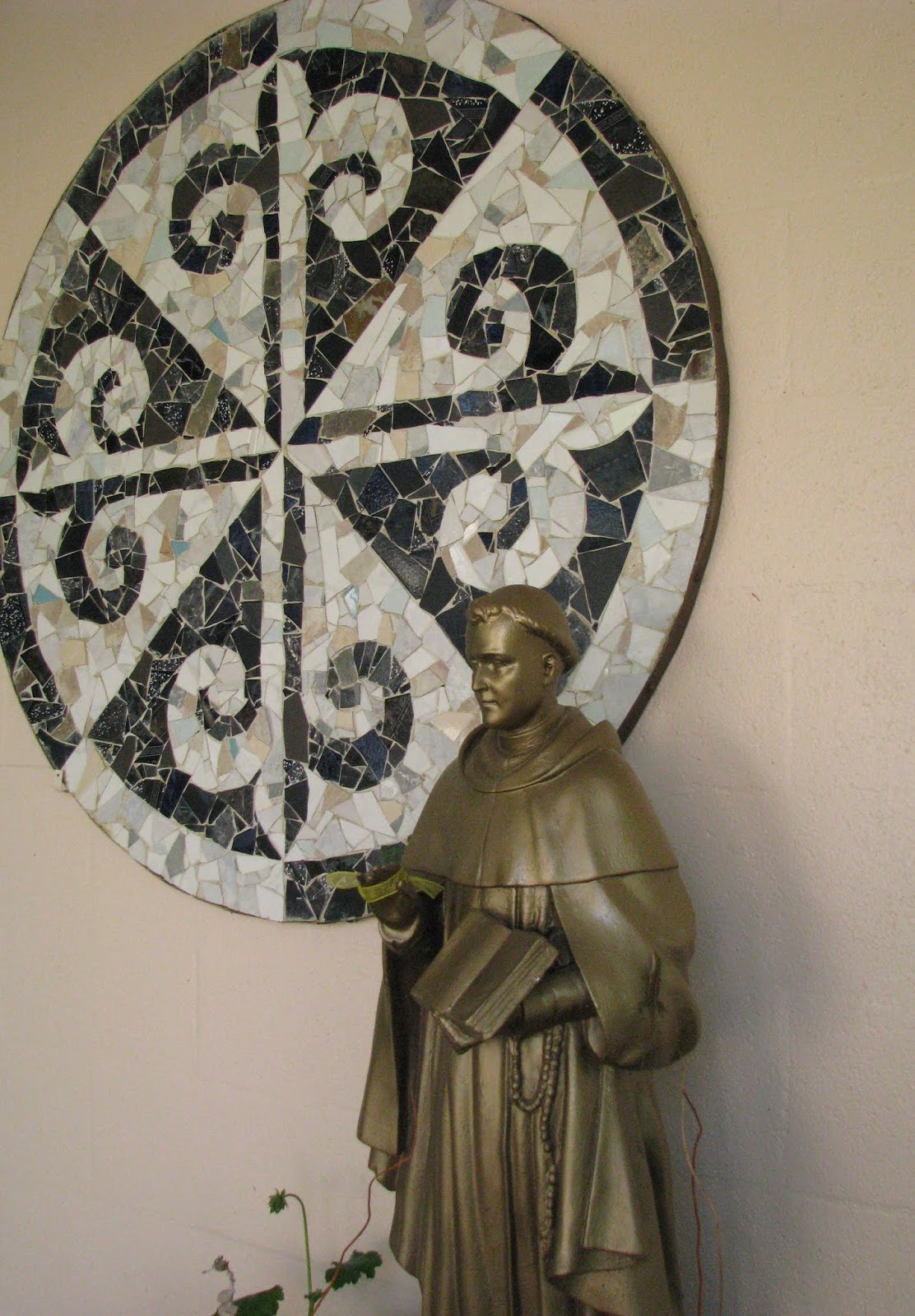
St. Dominic on outside walk-way

Men and women who dedicate themselves to the Consecrated Life are encouraged to have a retreat once a year. This week, we are coming to the end of our annual retreat in a few days. Every year we have a preached retreat by a Dominican friar. It is a wonderful time to have space for extra rest and prayer. Although, depending upon our duties and work assignments, we may still be called upon to continue fulfilling them.

This year we are having wonderful weather. The time of year for our retreat varies, depending upon our schedule and that of the preacher. In the picture below you can see that it is not only the nuns who rest, but also the “animal” members of our monastery.

One of our many lizards sleeps contently on St. Dominic\’s arm

A Visitor from Trinidad

We have had the joy of a visit from Sister Ann, prioress of the Dominican Monastery in Port-of-Spain, Trinidad. She has been here about a week and will continue to be with us for a few more days.

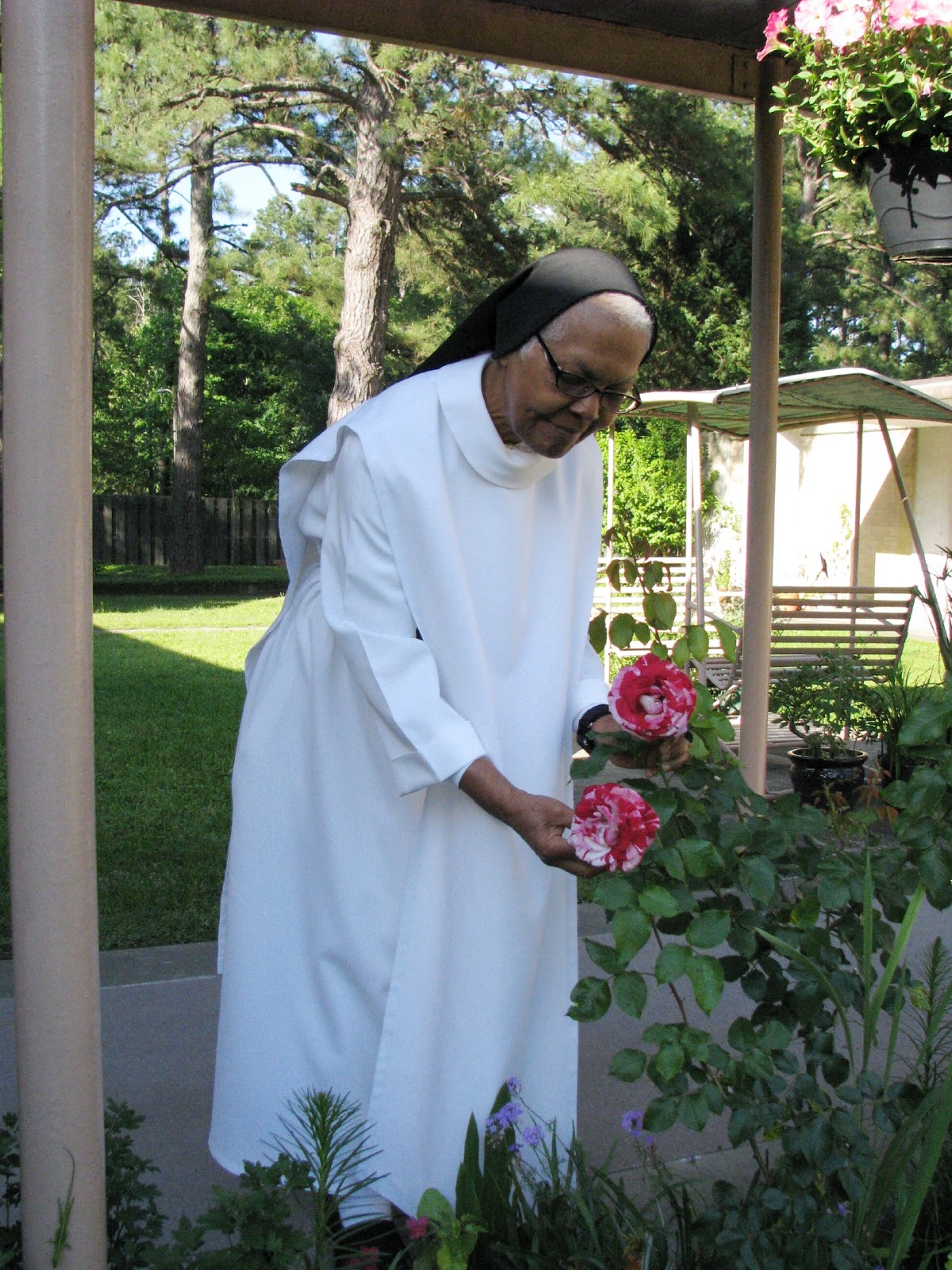
In the photo above, Sister Ann is admiring our “Rock & Roll” Rose bush. Of course, she\’s used to many exotic tropical flowers in Trinidad. We have known Sister Ann and her community for over 40 years. It has been a wonderful sisterly experience. Please remember Sister\’s brother, Victor, who died Saturday, on Sister\’s Birthday. May he rest in God\’s peace.

Holy Saturday 2019

From a famous ancient Holy Saturday homily:

Something strange is happening–there is a great silence  on earth today, a great silence and stillness. The whole earth keeps silence because the King is asleep. The earth trembled and is still because God has fallen asleep in the flesh and he has raised up all who have slept ever since the world began. …


Jesus has died and been buried. We all know what it is like to lose someone we love. Everything in life seems empty and useless. Our lives as nuns revolves around the chapel. Now it is empty – empty of the One Who IS our life. Every Church in the world is empty – stark – bare – just a room, a building, that has lost its purpose for existing. And this is what our lives would be without Jesus.
On this day of emptiness and silence . . .
     let us renew our efforts to be faithful to our Baptismal and religious/marriage vows.
     let us renew our commitment to be faithful to Jesus Christ, our only Savior.

Good Friday 2019

Today is the most Solemn day of the year for Catholics. It is the day on which Jesus Christ gave His life to redeem all people from their sins. He poured out every drop of His blood to bring us to Heaven.

John 19:34 – But one of the soldiers pierced his side with a spear, and at once there came out blood and water. 

The piercing of Jesus\’ side is a most profound and meaningful mystery. Saint Thomas Aquinas speaks of it in his Commentary on the Gospel According to John.

Why does the Evangelist add, but when they came to Jesus and saw that he was already dead, they did not break his legs? … We are told why they pierced his side, because when the soldiers saw that he was already dead, they did not break his legs.

To make sure that Jesus was dead one of the soldiers pierced his side with a spear. It deserves notice that he does not say “wounded” but “pierced,” that is “opened,” because in his side the door of eternal life is opened to us: “After this I looked, and lo, in heaven, an open door!” (Rev 4:1). This is the door in the side of the ark through which those animals entered who were not to perish in the flood (Gen 7).
This door is the cause of our salvation; and so, at once there came out blood and water. This is a remarkable miracle, that blood should flow from the body of a dead person where blood congeals. If someone says that this was because the body was still warm, the flow of the water cannot be explained without a miracle, since this was pure water. This outpouring of blood and water happened so that Christ might show that he was truly human. For human beings have a twofold composition: one from the elements and the other from the humors. One of these elements is water, and blood is the main humor.
Another reason why this happened was to show that by the passion of Christ we acquire a complete cleansing from our sins and stains. We are cleansed from our sins by his blood, which is the price of our redemption: “You know that you were ransomed from the futile ways inherited from your fathers, not with perishable things, such as silver or gold, but with the precious blood of Christ, like that of a lamb without blemish or spot” (1 Pet 1:18). We are cleansed from our stains by the water, which is the bath of our rebirth: “I will sprinkle clean water upon you, and you shall be clean from all your uncleannesses” (Ez 36:25); “On that day there shall be a fountain opened for the house of David and the inhabitants of Jerusalem to cleanse them from sin and uncleanness” (Zech 13:1). So it is these two things which are especially associated with two sacraments: water with the sacrament of baptism, and blood with the Eucharist.
Or, both blood and water are associated with the Eucharist because in this sacrament water is mixed with wine, although water is not of the substance of the sacrament. This event was also prefigured: for just as from the side of Christ, sleeping on the cross, there flowed blood and water, which makes the Church holy, so from the side of the sleeping Adam there was formed the woman, who prefigured the Church.
 
Jesus teaches us the value of suffering with nobility and generosity. Whatever one\’s current state of suffering … hold a crucifix in your hands, look at it closely, and try to understand that He endured all this out of love for all of us.
H.T:  at Lifezette.com
 

Holy Thursday 2019

Today is a day of LOVE, especially of Our Lord at the Last Supper, when He washes the feet of His Apostles, institutes the Sacrament of Holy Orders and the Sacrament of the Eucharist.

Peter is embarrassed to have Jesus wash his feet. But the Lord, tells Peter,  “What I am doing you do not know now, but afterward you will understand.” Our guide this Lent, St. Thomas Aquinas, reflects upon this sentence. [The words in red are ours.]
 
In (v 7), we see the words of Christ, which show that this action is a mystery. Christ said to Peter: What I am doing you do not know now, but afterward you will understand. This action is both an example and a mystery. It is an example of humility to be practiced: “For I have given you an example, that you also should do as I have done to you” (v 15) And it is a mystery because it signifies an interior cleansing: “He who has bathed does not need to wash, except for his feet” (v 10).
So what Christ said can be understood in 2 ways.
     In one way, What I am doing you do not know now, that is, you do not now understand that what I am doing is an example; but afterward you will understand, when he explained it to them saying: “Do you know what I have done to you?” (v 12).
      In another way, What I am doing you do not know now; that is to say, this is a mystery and something hidden, and it signifies an interior cleansing which only I can accomplish, and which you do not understand now, but afterward you will understand, when you receive the Holy Spirit: “I have yet many things to say to you, but you cannot bear them now. When the Spirit of truth comes, he will guide you into all the truth” (16:12).
 
Today, Jesus gives us an example of humility and selfless charity. He also gives us HIMSELF.

“Jesus is fully present in every Catholic church around the world… He is fully present, and He patiently waits and hopes for us to arrive for a heartfelt visit.”
H.T:  at Lifezette.com

Spy Wednesday 2019

Today is called “Spy Wednesday” because the Gospel from Matthew (26:14-25) recounts when Judas went to the high priests to betray Jesus for 30 pieces of silver. Jesus forewarns the other Apostles that the betrayal will soon take place.

St. Thomas Aquinas, in his Commentary on the Gospel of Matthew, makes some points about Judas.
Judas Iscariot… Who betrayed him. Why is he listed? To give an example that dignity of rank does not make a person holy. Another reason is to remind us that it scarcely happens that in a large group someone is not evil. Therefore, he is listed to show that good persons are sometimes not without wicked ones: “As a lily among thorns, so is my love among the daughters” (Song of Songs 2:2). Augustine: “My house is not better than the Lord\’s house.” …

Palm Sunday 2019

Today we begin our journey into the holiest week of the entire year. As with all the Sundays of Lent, we are still traveling with St. Thomas Aquinas. This day he comments on the cry of the Jews, which the Church has incorporated into the Holy, Holy, Holy, of the Mass.


The Evangelist says [the crowd in Jerusalem that first Palm Sunday morning went out to see Jesus and then] he mentions how they conducted themselves.

First of all, they took branches of palm trees.
Now the palm, since it retains its freshness, signifies victory. In antiquity it was conferred upon conquerors as a symbol of their victory. We read in Revelation (7:9) of the conquering martyrs that they held “palm branches in their hands.” So the branches of palm trees were given as praise, signifying victory, because our Lord was to conquer death by dying and to triumph over Satan, the prince of death, by the victory of the cross. … 
Then, the Evangelist mentions what they said:
they shouted out Hosanna! Blessed is he who comes in the name of the Lord, the King of Israel!
Here they combine both petition and praise. There is petition when they say, Hosanna, which means, “Save us, I implore you.” It is like saying: hosy, which means “save,” and anna, which means “implore.” According to Augustine, this is not a word, but rather an exclamation of one praying. And it is quite proper that they should ask the Lord Jesus for salvation, because we read in Isaiah (35:4): “Behold your God…He will come and save you”; “Stir up thy might, and come to save us!” (Ps 80:2).
They praise him for 2 things: for his coming and for the power of his reign or kingdom. 
They praise his coming when they say,
Blessed is he who comes in the name of the Lord.
To bless is to speak good things. Now God blesses us in one way, and we bless God in another way. For when God blesses us he makes us good, since for God to speak is to do: “For he commanded [that is, spoke], and they were created” (Ps 148:5). But when we bless God, we profess his goodness: “We bless you from the house of the Lord” (Ps 118:26); “Blessed be everyone who blesses you!” (Gen 27:29). Therefore, Blessed is he who comes in the name of the Lord, for Christ worked in the name of God, because everything he did he directed to the glory of God.
Now because both the Father and the Son are the Lord,
the phrase, in the name of the Lord,
can be understood in two ways.
In one way, Blessed is he who comes in the name of the Lord, means blessed is he who comes in his own name, as Lord: “The Lord is our ruler” (Is 33:22). Moses did not come in the name of the Lord in this way, because he came as a servant: “Now Moses was faithful in all God\’s house as a servant, to testify to the things that were to be spoken later” (Heb 3:5). According to Augustine, the better interpretation would be to say that in the name of the Lord means in the name of the Father. For Christ\’s words direct our minds to this: “I have come in my Father\’s name” (5:45). Further, there are two ways in which Christ is said to have come in the name of the Father. First, he came as the Son, which implies the Father; secondly, he came to manifest the Father: “I have manifested thy name to the men whom thou gave me” (17:6).
The people praise the power of his reign when they say, the King of Israel! Literally, the Jews believed that he had come to reign over them temporally, and ransom them from subjection to the Romans. That is why they hailed him as a king: “He shall reign as king and deal wisely” (Jer 23:5); “Behold, a king will reign in righteousness, and princes will rule in justice” (Is 32:1).