Advent Companions: Fr. Alfred Delp, SJ

 \”More, and on a deeper level than before, we really know this time that all of life is Advent.\”–Fr. Alfred Delp
 
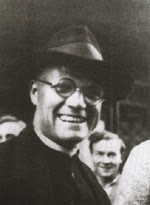
Our final Advent companion is a man who has not been formally canonized, but whose writings on Advent are beautiful and moving. Alfred Delp, SJ was a German Jesuit priest who was executed by the Nazis on February 2, 1945. Fr. Delp was a a great preacher and a critic of the Nazi regime, working actively against the Nazis. One collection of his writings in English, Advent of the Heart (published by Ignatius Press) brings together several Advent sermons and writings from prison as well as an Advent play he wrote. On the third Sunday of Advent in 1944, while incarcerated in Tegel Prison, Fr. Delp wrote on the theme of joy, which is fitting for Gaudete Sunday: \”In order to be capable of true life, man must live according to a specific order and relationship to God. The capability of true joy and of living joyfully is itself dependent upon specific conditions of human life, upon particular attitudes regarding God. Where life does not perceive itself as taking place in community with God, it will be gray and gloomy and drab and calculating.\” This is the secret of Advent joy: our communion with God. If we are in communion with Him, everything becomes pure joy, regardless of exterior situation. Without Him the happiest celebration becomes like dust and ashes. Fr. Delp reminds us that our whole lives are a kind of Advent as we await the coming of the great King at the end of our lives. Let us be ready to meet Him when He comes!

Advent Companions: Blessed Margaret of Savoy, OP

 
Blessed Margaret of Savoy was a fifteenth century Dominican nun. She was (as her name reveals) a member of the royal house of Savoy and related to all kinds of kings, queens, and even an antipope (Clement VII). Although she had always wanted to be a nun, she married Theodore Paleologus, marquis of Montferrat, for reasons of state. Their marriage was reasonably happy and after his death she resolved not to remarry. She was 36 at the time. She first became a Dominican tertiary and later, by permission of Pope Eugenius IV, a Dominican nun. She formed a community at Alba and lived there until her death. 
Margaret had a difficult life as a nun. Early in her religious life, she had a vision of Christ offering her three arrows labeled \”Sickness, Slander, Persecution\” and she suffered from all three of these. However, she saw God\’s hand in all her trials, and was able to carry on. Margaret is a good companion during Advent for two reasons. First, she was able to work cheerfully and devotedly for God under all circumstances, traits so needed during this season when we should all be happy and full of joy but when it is also easy to become depressed or angry. Second, Margaret had a pet deer that used to follow her around (yes, even indoors) and keep her company, even running errands for her when she needed things done. The deer would knock on a sister\’s door when Margaret needed her, and then lead the sister to Margaret. This is a bit farfetched, but at this time of year when we sing happily of flying reindeer, it doesn\’t seem entirely improbable! (Or does it?) Let us continue on our way with Margaret and all the holy Dominican women this Advent, who looked forward to the birth of Christ not only in time but in their hearts and souls.
Christmas Novena 2014

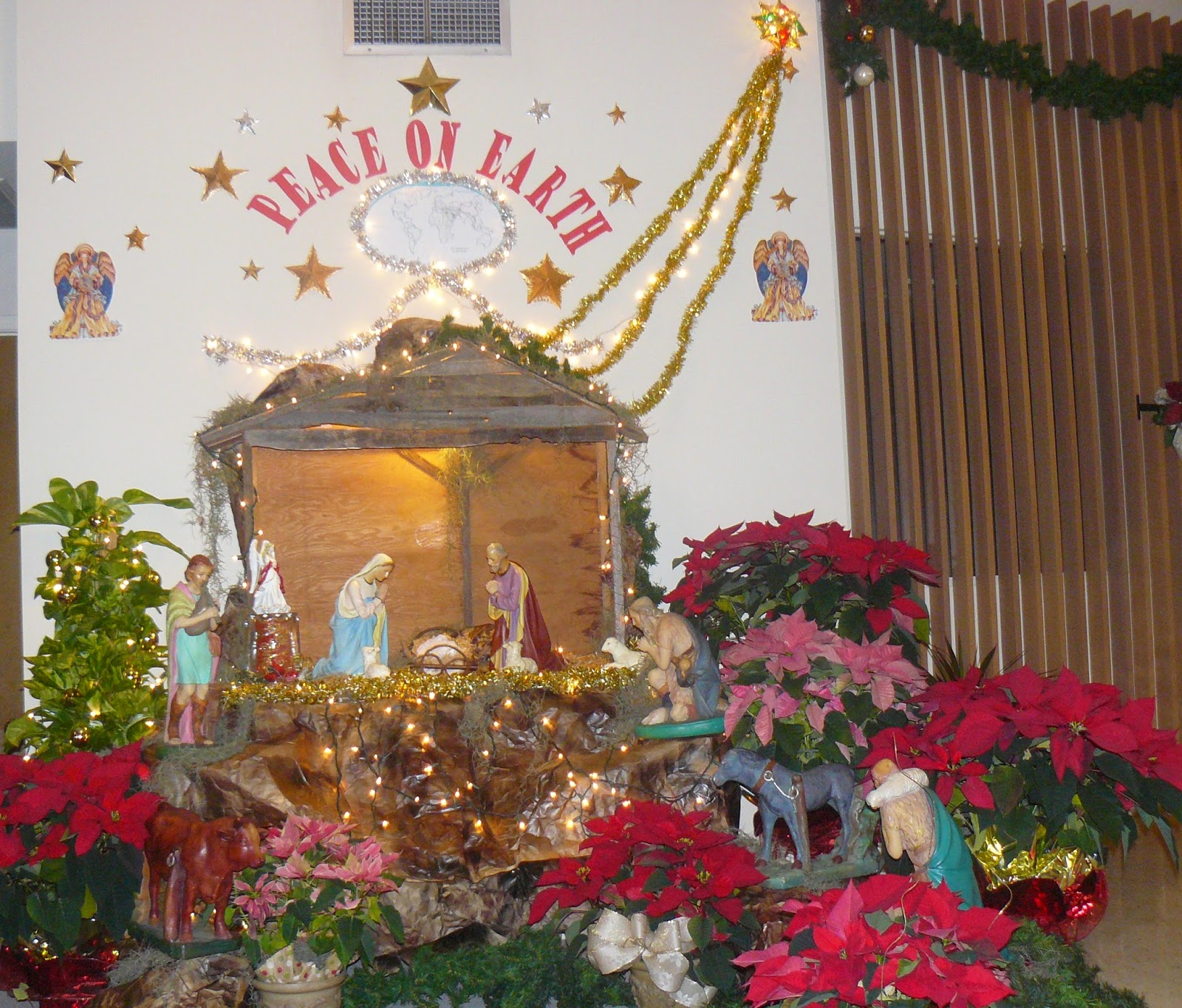
Today begins our annual Christmas novena of prayers and sung Masses. As always we remember all of you who read this blog in our prayers! If you have a special intention you\’d like us to remember this year, please contact us and let us know what it is. Or you can keep it in your heart and let it be known to God alone. Whatever your prayers this Advent season, know that we are joining ours to yours and to the prayers of all the universal Church. Let us all together continue our Advent journey to the joy of Christmas and the incarnation of Our Lord.

Sr. Maria Guadalupe\’s Feast Day Celebration–2014

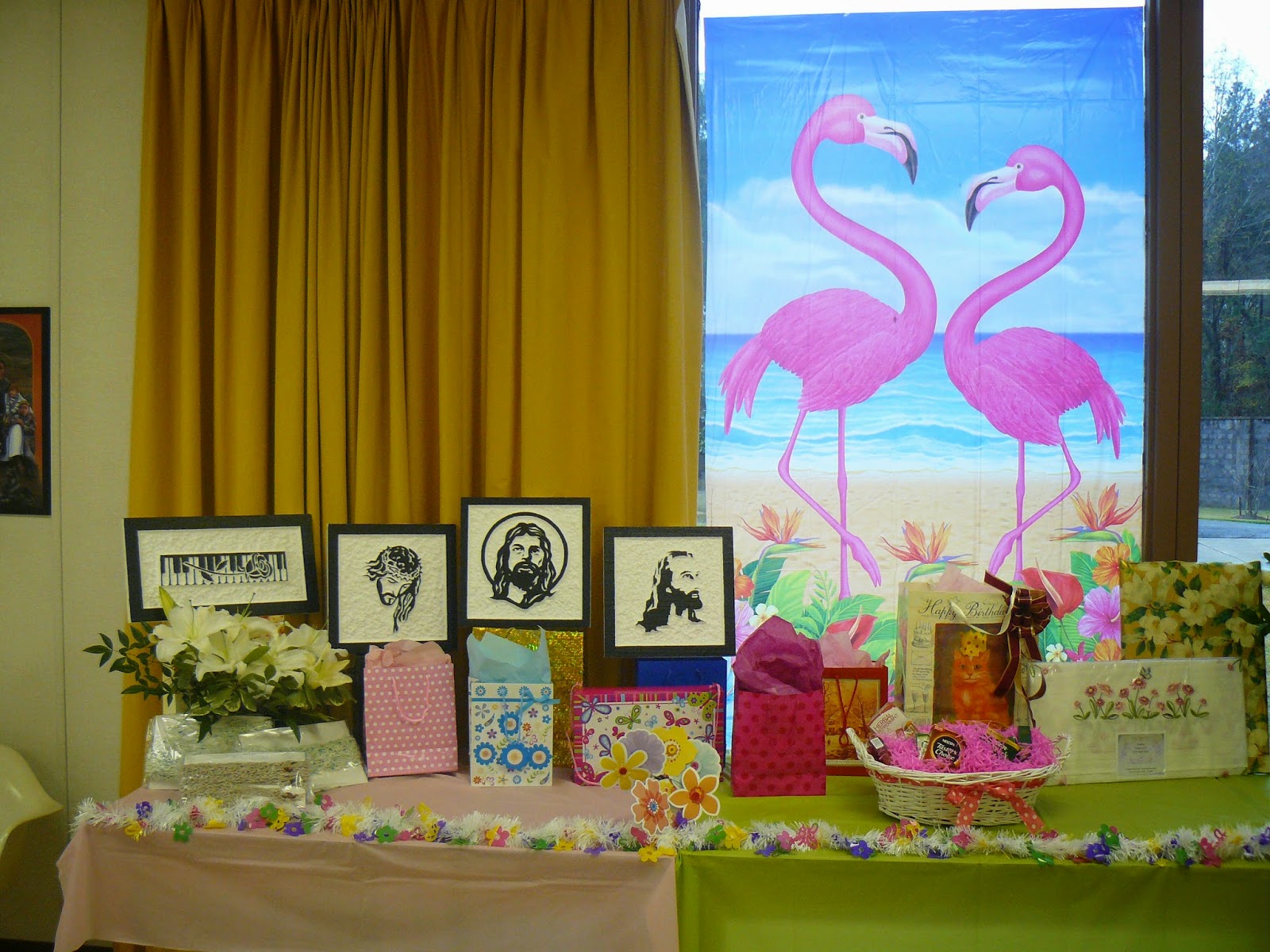
On Saturday we celebrated Sr. Maria Guadalupe\’s feast day–which of course actually falls on December 12, but Saturday is a better day for a celebration!
We had a \”flamingo\” theme for the party!
In these pictures, you can see some of Sister\’s many gifts and surprises.
We spent the morning playing a fun game of \”Flamingo Bingo\” (which is basically regular bingo with flamingo trivia included). In the afternoon we met again in the community room to watch Sister open her gifts. 
A cute doll made by one of the sisters. She made all the clothes for the doll too, except the shoes!
Sister received a fascinating book explaining how to make pine needle baskets–a traditional art practiced by Native Americans in this part of East Texas. Will this be our next project? 
A gorgeous cross-stitch of Our Lady of Guadalupe done by one of the sisters. This was one of many beautiful handcrafts given to Sister. 
We concluded our fun day with a showing of the movie \”The Miracle of Our Lady of Fatima\”. It was a delightful celebration. We are so thankful for Sr. Maria Guadalupe and her leadership of our community. May God grant her many blessings!

Visiting Friars: Fr. Ramon Gonzalez, OP

Recently we enjoyed a visit with Fr. Ramon Gonzalez, OP, of our Dominican province of St. Martin de Porres (the southern province). He came to our monastery to visit our chaplain, Fr. Marcos Ramos, OP, and graciously met with us on Friday evening. Father Ramon is an accomplished flautist and spent most of the visit entertaining us on the flute: 

As you can see in the picture, this is no ordinary flute, but a special wooden flute–a replica of the flutes used in the 1600s. It is pitched a half step lower than modern standard pitch tuning, and has a mellower sound than a metal flute.  Father plays his flute with a group in his area, as well as using his music as part of his ministry to the elderly. He also teaches classes in music and preaching from time to time. We had an interesting and educational visit with Fr. Ramon, and hope he will stop by again if he is ever in the area!

Advent Companions: St. Barbara

St. Barbara was one of the Fourteen Holy Helpers in medieval times, especially invoked against sudden death (which is why she has become the patroness of electricians, artillery gunners, etc.). Although she was removed from the General Calendar of the Catholic Church in 1969, she is still venerated by the Eastern Orthodox and the Anglicans. Barbara was a martyr, possibly in Greece, who converted to Christianity against her father\’s wishes and was later killed by him. A bolt of lighting struck him dead as soon as he had killed his daughter. St. Barbara is also the patroness of builders and architects, because she proclaimed her new-found faith by insisting on the addition of a third window in her new bath house–three windows to honor the Holy Trinity. We have a statue of St. Barbara in the infirmary of our monastery, possibly as a holy reminder of the fragility of life. 
St. Barbara is an Advent companion because she was a woman of great integrity. When she found the truth, she lived it, regardless of the consequences. And she proclaimed her faith to the world through her willingness to die rather than give it up. In the times we live in, our Christian faith is often held up to mockery and hatred. May we, like St. Barbara, find the courage and singleness of heart to hold fast to the faith in the face of so many temptations to take the easier road, to lead a quiet life, to keep silent. May we call out from our modern-day towers, \”Throw open the third window / In the third name of God.\” (G.K. Chesterton)

Advent Companions: St. Juan Diego

\”Listen and understand, my humblest son. There is nothing to frighten and distress you. Do not let your heart be troubled, and let nothing upset you. Is it not I, your Mother, who is here? Are you not under my protection?\” –Our Lady of Guadalupe to Juan Diego
Juan Diego and his family were among the first Indians to embrace the Catholic faith when it was brought to the land we know today as Mexico. The story of the apparitions of Mary to Juan Diego are well known. It is touching to remember that one day, when Juan Diego was hurrying to visit his sick uncle, he took a different route for fear of being detained by Mary–but she found him, anyway, and cured his sick uncle as well. After the miracle of the tilma and the construction of a church on the hill of Tepeyac, tradition holds that Juan Diego lived as a hermit near the church, caring for pilgrims who came to visit the miraculous image and worship the true God. 
Juan Diego is a companion for us during Advent because of his humility and obedience–virtues which are also traditionally associated with the Virgin Mary who appeared to him. Although he was rebuffed several times by the bishop, who did not believe in the apparitions at first, Juan Diego continued to return and make Mary\’s requests known to the bishop. Juan Diego valued the good graces of God above any human opinion, and he trusted in Mary, his mother and ours. May we imitate him as we continue our way through this Advent season!