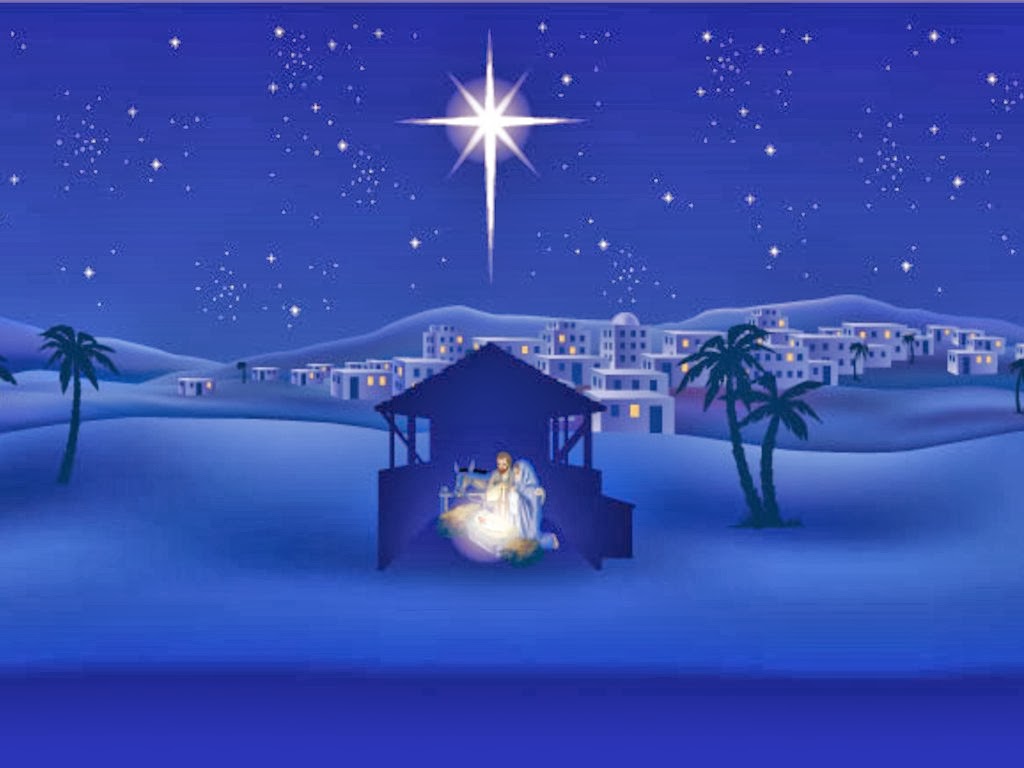
Questions Answered: Advent Edition

Q: I notice you have posts about things you do at Christmas, but how do you celebrate the season of Advent?
A: We have a lot of things we do during the Advent season. Primarily of course we pray and keep a special silence, awaiting the coming of Christ. The Advent liturgies and Mass readings give us much to contemplate.
We also put up an Advent wreath. Actually, we have about three: one in the chapel, one in the refectory, and one in the novitiate. The candles on the chapel wreath are lit for Mass and Morning Prayer and Vespers; the refectory wreath candles are lit for our evening meal (and accompanied by special prayers) and the novitiate traditions vary according to times and circumstances.
We do some penance during Advent. Advent is not a major penitential season like Lent, but it is a time for doing some extra little things to help prepare for Christmas.
During many Advent seasons, one of the matachines groups from our local parishes comes out and dances for us in honor of Our Lady of Guadalupe. This is always an exciting event!
Q: Do you go Christmas caroling? 
A: We save Christmas carols for the Christmas season. When we sing during Advent, we sing Advent songs and hymns like \”O Come, Divine Messiah\” and \”O Come, O Come, Emmanuel\” (just to name two most people know). We often go caroling through the monastery during the Christmas season (that\’s December 25 until the Baptism of the Lord) and it\’s a lot of fun! Not too cold either because we mostly stay inside!
Q: OK, I\’m curious. What about Santa Claus? 
A: Being Dominicans, we take a theologically nuanced view of this concept. Of course we know there was a St. Nicholas who (according to questionable legend) not only supplied poor but deserving girls with much-needed dowries, but also attended the Council of Nicaea and defended the true faith against the Arian heresy. So, in a sense, yes, we believe in Santa. But we don\’t exactly decorate with images of Santa Claus, or even St. Nicholas (although OK, yes, we have a few little things…). Hey, we don\’t even start decorating for Christmas until about December 22! That\’s part of keeping the spirit of Advent. And when we decorate, we have mostly nativity scenes or creches, with Mary and Joseph and the baby Jesus and later the wise men, instead. That\’s the way we operate. But there\’s nothing wrong with Santa, or St. Nick, as long as you look at the whole picture of what Christmas (and Advent) is all about…which is the coming of Christ into our world, to save us.    

2nd Sunday of Advent, 2013

Almost every Scripture reading and prayer in today\’s Liturgy speaks of all the nations seeing the salvation of God. Let\’s examine the entrance antiphon: 
People of Zion, behold the Lord will come
to save the nations,
and the Lord will make the glory of his voice heard,
to the joy of your hearts.
Augustine wrote that \”Peace is the tranquility of order.\” We see in the universe an astounding order to things. When God began the work of redemption there is also a refined order. He chose specific people and events to set this work in motion. From the choice of Abraham and the patriarchs, God founded the Jewish people. 
As this people grew, especially in their self-identity, they came to believe they were the only ones to be saved because they had the divine revelation–the promises, covenants and laws. But in the course of time God raised up a great prophet, Isaiah. Part of his message was to correct the people\’s myopic vision of salvation and to expand it to a universal salvation. God\’s gifts of redemption are open to everyone who responds to his call. God chose the Jewish people, the people of Zion, in order to bring all other nations to a love and knowledge of the one true God.

From the chosen Jewish people came Christ the Lord, the salvation of the nations. Thus, following their elder siblings in faith, the Church, the new people of Zion, carry on and extend this mission of proclaiming God\’s love to all the nations.

We have been given the tremendous gift of faith in our Lord Jesus Christ. This is not a secret to hoard, but an experience of love to share. Blessed John Paul II once said that \”faith is strengthened when it is shared.\” We also owe a profound debt of gratitude to the Jewish people for their fidelity to God\’s covenant through many trials. All people are called to live in peace and brotherhood in the family of God and to worship him together in peace!

How Charm-ing!

The Lufkin Daily News publishes a bimonthly magazine called Charm–and they featured our monastery in their December/January issue! You can read the article here (be sure to go to pages E24-E25 to see us!). You can also check out Charm magazine on Facebook here, and we understand they\’re also on Pinterest. Many, many thanks to Melissa Heard (author of the article) and Andy Adams (who took the cover picture and some of the ones inside too), and everyone who works on Charm!

1st Sunday of Advent, 2013

The word Advent is taken from the Latin adventus, meaning, \”to come\” and refers now to the liturgical season immediately before Christmas. Advent, as we know it today, began between the 9th and 10th centuries in Rome under the guidance of Pope Gregory I. The season was to begin on the Sunday nearest the feast of St. Andrew (November 30) and last four weeks or until Christmas. 
Pope Gregory included Christ\’s \”three comings\” as part of Advent: the commemoration of His coming at Christmas; the celebration of His coming into our hearts through grace each day; and the preparation for His second coming at the end of time. Advent is intended to be a time of joyful anticipation of Christ\’s coming rather than a strict penitential time like Lent, but we are still encouraged to practice self-denial for the sake of helping others, and to receive the Sacrament of Penance.

During Advent it is good to spend some quiet time reading the Scriptures and listening to what the Lord is telling us. In the Gospel for this first Sunday of Advent Christ urges his disciples to \”stay awake! For you do not know on which day your Lord will come.\” (Matthew 24:42) He refers to the people in Noah\’s time, who were totally unconcerned until the flood came and destroyed them (Matt. 24:39). The Lord, in His mercy, warns the people to listen to Him, and continues to do so through His word.

In today\’s first reading at Mass, Paul exhorts the Romans (and us): \”It is the hour now for you to awake from sleep. For our salvation is nearer now than when we first believed…Let us live honorably as in daylight…let us put on the Lord Jesus Christ and make no provision for the desires of the flesh.\” (Romans 13:11, 14) Paul tells us how to \”live honorably\” in the verses which proceed today\’s reading: \”Owe no debt to anyone except the debt that binds us to love one another…You shall love your neighbor as yourself.\” (Romans 13:8, 10)

Holy Mary, our Lady of Advent, pray for us as we begin this holy season of Advent in preparation and in anticipation of the birth of Christ, your Son, anew in our hearts and in our world. 

Christ the King, 2013

Often on this solemnity, preachers will begin by saying that in our modern day and age we do not understand the meaning of kings and queens, especially if we live in a democracy. However, we can easily understand Christ as our King if we think of the duties of a king in Biblical times. These duties were four-fold:
     –to represent the people
     –to protect the people
     –to establish peace and unity
     –to reward the good and punish the evil.
It doesn\’t matter whether one is a king or a president, senator or principal of a school. The basic issue is authority. How is it exercised? How is it obeyed and respected? Christ has transformed the meaning not only of kingship, but of any kind of authority. Authority is not for dominating others, but for service.  
Parenthood is an everyday image of authority. Although they hold a certain power over their children, parents become, in a sense, servants of their children. For years, parents change their entire way of life to feed, clothe, and care for their children. But there is no drudgery here, nor the resentment of a slave. All this self-sacrificing labor is performed out of love.
And this is the essence of Christ\’s Kingdom and Kingship–self-sacrificing love. If we want to be part of his kingdom, all we have to do is imitate him, become like him. The Preface for today\’s Liturgy describes Christ\’s kingdom as:
       a kingdom of truth and [divine] life,
       a kingdom of holiness and grace,
       a kingdom of justice, of love and peace.
Our Baptism and Confirmation give us the privilege and responsibility of participating in Christ\’s kingdom and serving as he does. The Year of Faith proclaimed by Pope Benedict XVI concludes today. Let\’s all pitch in and help continue the great work of evangelization so that countless other people may share in the Kingdom of Love. 

Presentation of Mary / Pro Orantibus Day, 2013

 
Today is a special day for cloistered communities, because this memorial of the Presentation of Mary in the temple is also Pro Orantibus Day, a day of prayer for cloistered contemplatives. We feel a special bond with Mary, who (according to legend) was chosen to serve God in the temple in what might be called a cloistered life before her marriage to Joseph and becoming the mother of our Lord Jesus Christ. Although this story of the Presentation is not found in the Bible, it is a very old tradition and worthy of respect for what it tells us about Mary: that she was dedicated even as a child, like Samuel in the Old Testament. She came from God-fearing parents who loved their daughter enough to give her to God as His handmaiden when He requested this favor. Today we also thank all the parents of cloistered contemplatives, who like Mary\’s parents have given their children lovingly and unselfishly for the service of God in His temple. May they all be blessed like Joachim and Anna, the parents of Mary! May many young women feel the call of God today to serve Him as a cloistered contemplative nun–perhaps a Dominican nun?

33rd Sunday in Ordinary Time, 2013

As the year ends, the Church selects readings to call us to be more attentive to the gentle voice of the Holy Spirit who has spoken to us by both the Old Testament prophets and the New Testament writings. Today the first reading is from the book of the prophet Malachi. We read that \”The sun of justice with its healing rays\”  is coming. And in the Responsorial Psalm, we read, \”The Lord comes to rule the earth with justice.\” These words can give us comfort, confidence in God\’s justice, and mercy, for St. John writes, \”God is love.\” Can we seriously understand the justice of God? And if we say that God is just, how can we also think of him as merciful or loveable? 
In an article in the Summa Theologiae St. Thomas Aquinas quotes St. Augustine: \”God\’s wisdom became man to give us an example in righteousness of living…\”  The word \”righteousness\” is like the word \”justice\”; they have the same meaning. In the Old and the New Testaments, we meet it a lot. Justice is one of the highest moral virtues because it pleases God and is inseparable from his love.
\”Learn to do good, search for justice.\” (Rm 13:18 and Is 1:17) St. Paul also mentions a gift of justification in his writings: it is from God through our Lord\’s redemptive sacrifice on the cross. God gave us a great example in our Lord Jesus Christ\’s loving, consecrated, humble acts. At the Last Supper, as the darkness fell, Christ showed his followers great love from his heart in giving them the wonderful gift of his own sacrifice–his body and blood–the wonderful sign of love being completed as he knelt and washed their feet. Then he dried their feet with a towel. In humility, Christ embraced the lowliness of his passion willingly in order to lead us back to the Father\’s love. That is, \”God\’s mercy is so abundant, and his love for us is so great, that while we were spiritually dead in our disobedience he brought us back to life with Christ. It is by God\’s grace that you have been saved.\” (Eph 2:4-5)
The Day of the Lord draws near, we come closer to the mystery of God\’s infinite love as he is always showing justice and is just.  Christ is absolutely able to provide the goodness and love for all, because God has loved justice and offered us a chance to participate in his divinity, as his Divine Son became human. The Sun of Justice, who is God, shines within us.