Everything Appropriate To Its Time

205 Pocket Watch Drawing Illustrations, Royalty-Free Vector Graphics & Clip  Art - iStock

In today’s reading from Ecclesiates, Qoholeth (or Solomon) says, “I have considered the task that God has appointed for the sons of men to be busied about. He has made everything appropriate to its time, and has put the timeless into their hearts, without man\’s ever discovering, from beginning to end, the work which God has done.” In other words, our job is to concentrate on the work we have to do int he present moment, without being concerned for the future known only to God. It’s hard to live this concept, though! Especially right now, when our society is turned upside-down by worries of all kinds, particularly the coming national elections and the pandemic.

In The Screwtape Letters, C.S. Lewis\’ famous epistolary novel composed of letters from an experienced tempter to his young nephew trying to steal a soul from God for the first time, this crisis of the future is  neatly summed up:

Your patient will, of course, have picked up the notion that he must submit with patience to the Enemy’s will. What the Enemy means by this is primarily that he should accept with patience the tribulation which has actually been dealt out to him–the present anxiety and suspense. It is about this that he is to say, “Thy will be done,” and for the daily task of bearing this that the daily bread will be provided. It is your business to see that the patient never thinks of the present fear as his appointed cross, but only of the things he is afraid of. Let him regard them as his crosses: let him forget that, since they are incompatible, they cannot all happen to him. (from Letter VI)

C.S. Lewis goes to on explain the state Screwtape hopes to see his nephew’s “patient” in: a fog of confusion wherein he is constantly thinking, “If A happens, I can do B; if B happens (and I hope not!), I can do C; if A and B both happen (unlikely, but who knows?) I could always do D, and if everything else fails there is always E or F.” While this may sound like common prudence, it isn’t. The best thing we can do is simply place our lives, our very selves into God\’s hands, and let Him be about His business day by day.

Screwtape continues to his nephew Wormwood:

To be sure, the Enemy wants men to think of the Future too–just so much as is necessary for now planning the acts of justice or charity which will probably be their duty tomorrow. The duty of planning the morrow’s work is today’s duty; though its material is borrowed from the future, the duty, like all duties, is in the present….He does not want men to give the Future their hearts, to place their treasure in it. We do….We want a man hag-ridden by the Future–haunted by visions of an imminent heaven or hell upon earth–ready to break the Enemy’s commands in the Present if by so doing we make him think he can attain the one or avert the other. (from Letter XVI)

We all fall prey to this temptation to one degree or another. We avoid it by placing our trust in God and His perfect timing day by day, moment by moment. Our Lord told us, “Sufficient unto the day is the evil thereof.” We have enough to occupy ourselves in the present without worrying about the future. Let us take concrete action at the appropriate time: voting in the election, wearing a mask and taking other precautions when we go out, whatever is needed in the moment. God will give us the grace we need in every trial, but He will only give it when the trial comes.

The White Scapular

During our retreat, Fr. John Sica, OP reminded us of a few things characteristic of Dominicans that we thought might be interesting to highlight here on the blog. One of these is the Dominican “white scapular”.

People sometimes ask us, anxiously, if we are wearing a brown scapular. This refers to the Carmelite brown scapular and its famous promise that those who wear it will be delivered from Purgatory by our Blessed Mother after they die.We usually smile and say, “No, but I am wearing a white scapular.”

“It’s not the same,” they insist. “The brown scapular is the only one that can save you.”

There\’s nothing wrong with wearing the brown scapular if it inspires you to lead a better life, go to Confession regularly, and have a devotion to Mary. But no mere scapular, white, brown, green, or any other color, is a Get Out Of Purgatory Free ticket.

That being said, why do Dominicans wear a white scapular?

A scapular was originally a kind of work-apron, meant to guard the habit from wear and tear and stains. So when St. Dominic began founding the Order, he had his new followers wear a habit like his, which happened to be the habit of the Augustinian canons: a white habit with a white hood (capuce) and a belt, and shoes (sandals are permitted today). There was no scapular, because they weren’t planning to do a lot of manual work. Their work would be intellectual.

And then Blessed Reginald of Orleans came on the scene.

Reginald was a priest and a canon lawyer before he met Dominic in Rome, in about 1218. He was dissatisfied with his somewhat worldly life and wanted something more, and had long conversations with Dominic about the new Order of Preachers. Still, he remained undecided until he fell extremely ill. One evening, as he lay on his sickbed, he had a dream in which the Blessed Virgin Mary came to him and anointed him. Holding out a Dominican habit, she also told him that if he put on this garment he would be saved. Our Lady’s version of the habit included a white scapular. When Reginald awoke, he was completely cured. He entered the Order and received the habit–with the white scapular added. And Dominicans have worn this white scapular ever since. (Usually with hands neatly tucked under.)

So, Our Lady plays a big part in the Dominican devotion to the white scapular, which (unlike most work aprons) is formally blessed when a brother or sister makes profession. Sometimes Dominicans even say (modestly) that the Dominican habit is special because it was a particular gift from Mary.

But why don’t Dominicans go around promoting the white scapular? Well, as we mentioned above–it\’s a part of the habit. It is also given to members of the Dominican Laity when they make profession as a sign of their part in the Order. It doesn’t carry any universal promises of blessings for the general public.There are other white scapular out there in Christendom that may carry such promises with them, but not the Dominican scapular.

If you are interested in a Dominican devotion that does carry promises, we highly recommend the Rosary. But that’s a huge topic! Maybe we\’ll look at that another time…

Annual Retreat

We\’ve been on retreat the last week or so!

Father John Sica, O.P., gave us a retreat on the theme of the Image of God. He used many examples taken from the lives of our own Dominican saints, which we found especially fruitful for meditation. In a nod to our prioress, Sr. Mary Margaret, he gave one conference using St. Margaret of Hungary as an exemplar for the Dominican nuns to follow. Of course, one would need to be prudent in this regard, because while Margaret was generous, self-sacrificing, humble, joyful, pious–all things a good Dominican nun should be–she also tended to disdain things like baths and clean habits. Obviously the source must be considered when imitating most saints of centuries past!

In addition to Father\’s conferences, we enjoyed a few days of “silent” retreat, which has become a feature many of us enjoy. Since the schedule is more free, we are able to spend our time in prayer, lectio, and other activities for a much longer period than usual.

Father John is a Dominican friar from St. Joseph\’s province (or, the eastern province). He has been living at Holy Rosary Priory in Houston the last two years attending classes at the University of St. Thomas. He has come before to give classes and to make his own personal retreat, so he was not entirely a stranger. We were especially lucky to get him for our retreat in these times of pandemic. He drove straight from Houston to Lufkin and always practiced social distancing when he was around us. It is always such a joy to get to know another of our Dominican friars!

We emerged from our retreat spiritually refreshed and ready to return to our daily work and routine. So far none of us has contracted COVID-19, although our chances are probably smaller because we don\’t get out much. Still, we continue to pray for a speedy end to the pandemic–with a vaccine, or some other help–and we pray for all of you in the world who are struggling so much more than we are. This was an important intention during our retreat.

It is our privilege to pray for you, always and at all times!

The Great Raffle Drawing

August 15 was the auspicious day chosen for our raffle drawing, and so in the afternoon after Rosary and prayers, we gathered in the community room to see who would win our 2020 Raffle prizes.

It\’s not exactly the Academy Awards, or the accounting firm of Price – Waterhouse, but our Guild sisters did their best to keep track of the many, MANY tickets that were sent in.
Our prioress, Sr. Mary Margaret, gave the tickets a first shuffle as subprioress Sr. Mary Rose looks on.
OK — let’s start drawing!!
Several sisters took turns drawing.
Sr. Mary Jeremiah graciously modeled the prizes for us (or held them up for viewing, as the case may be)
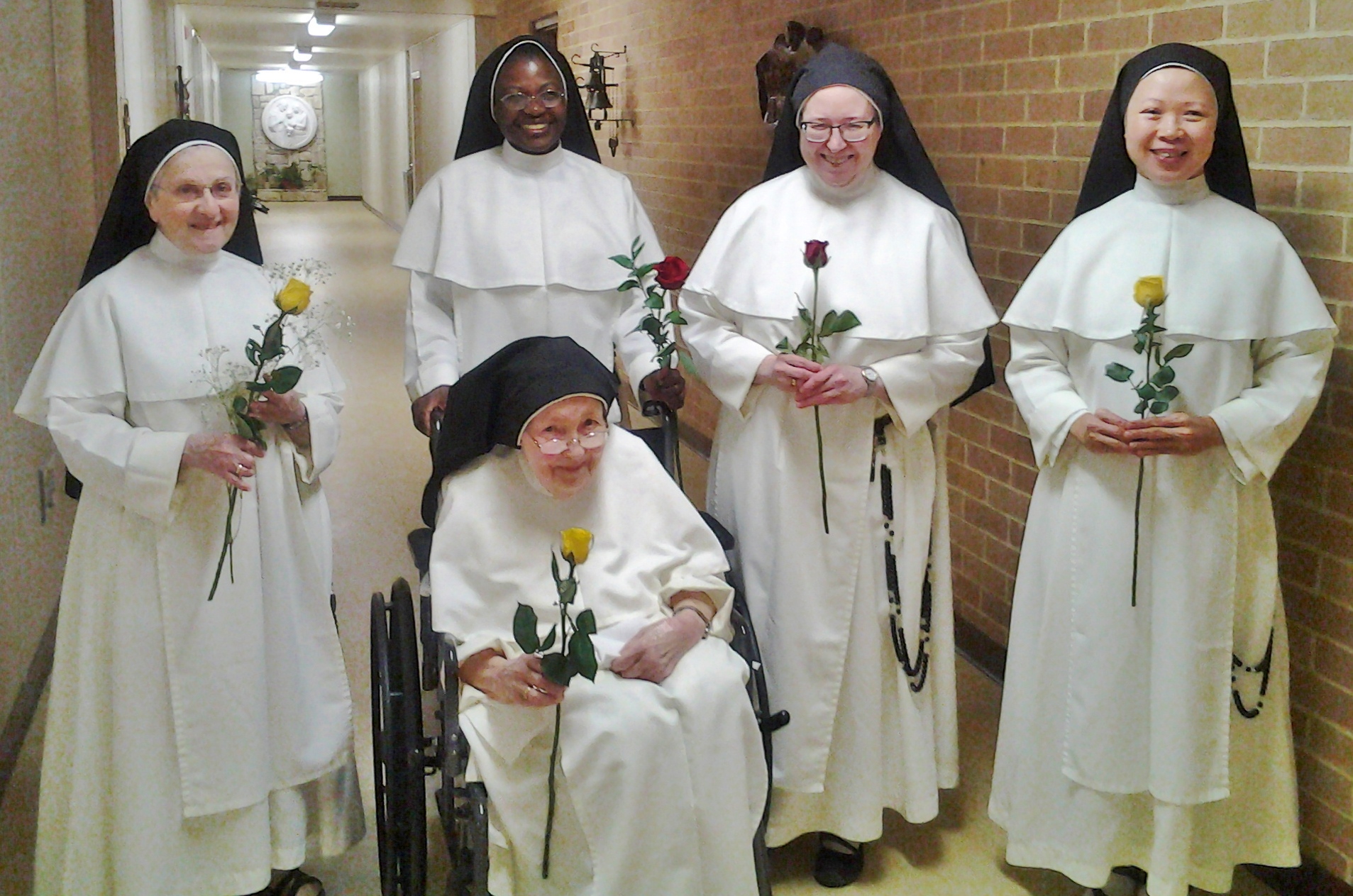
And we had some “surprise” prizes as well, modeled above by our sisters. Sr. May Annunciata, in the middle, is holding a regular prize. It’s yellow, a color she loves, and August 15 is her birthday, so we wanted to give her a chance to be seen here on our blog.

We are just immensely grateful to all of you who entered, and for all your kind donations, whether monetary or spiritual!

Are you wondering whether you won a prize? We\’ll be calling to let you know over the next few days. Stay alert!

St. Dominic’s Day 2020

Although we’re a bit late, we wanted to share some of our St. Dominic\’s Day festivities with you.

We began the day with the most important matters: the Liturgy of the Hours and a wonderful Mass in honor of our Holy Father Saint Dominic.

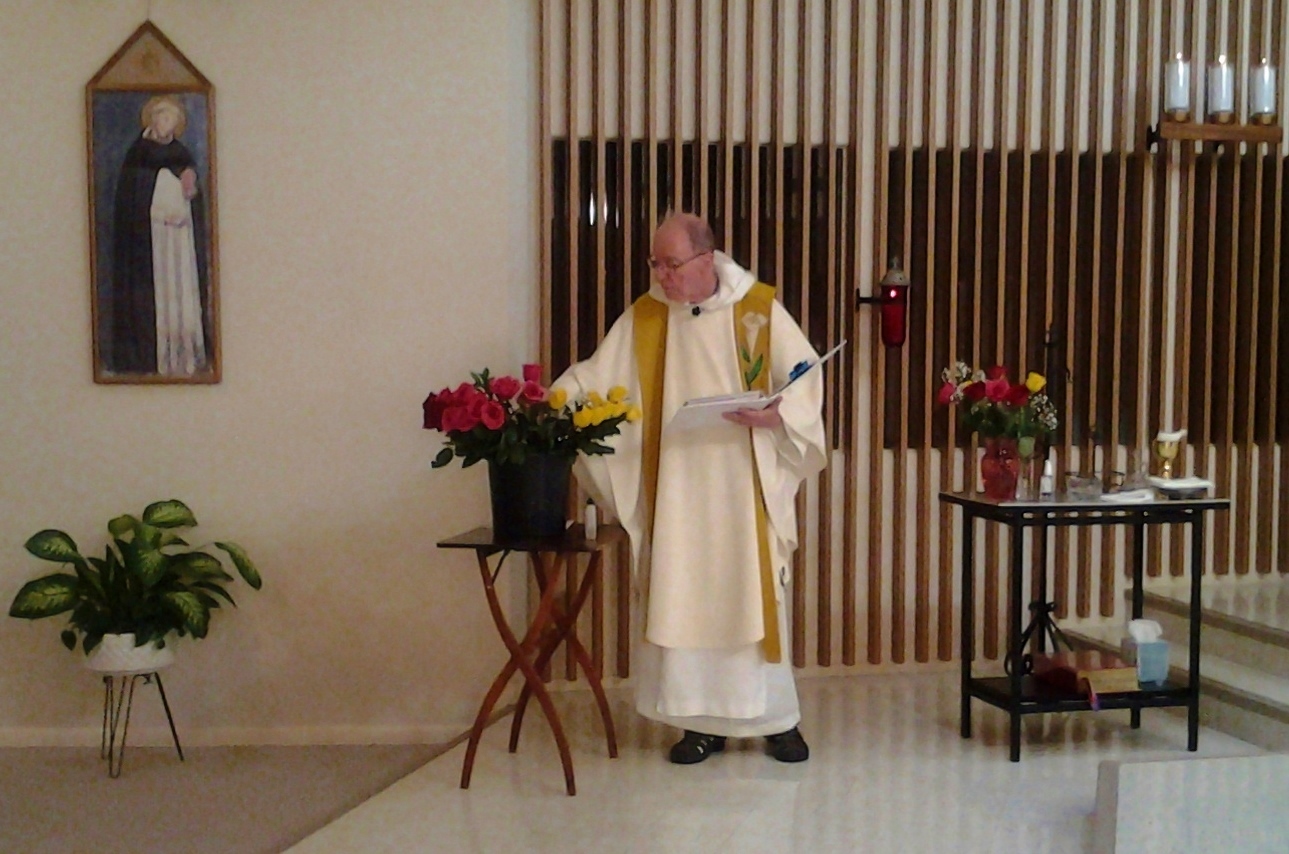
Father John Lydon, OP, our chaplain, with some of the members of our Dominican Laity and two religious from the Dominican Sisters of Our Lady of Fatima. We promise, after this picture everyone put their masks back on and started practicing good social distancing!
Our two Dominican sisters were able to spend most of the day at our monastery. Several sisters from their community, which has its motherhouse in Puerto Rico, serve in our diocese of Tyler.
Meanwhile, the cloistered sisters helped in the kitchen, mindful of the decorum due on such a special day and being appropriately subdued. Well, maybe not so much!
When the kitchen was in good order, we all gathered in the community room to sing a feast day song–“Dominique”. We sang it in English since none of us speaks French. (Now, if it had been in Spanish…)
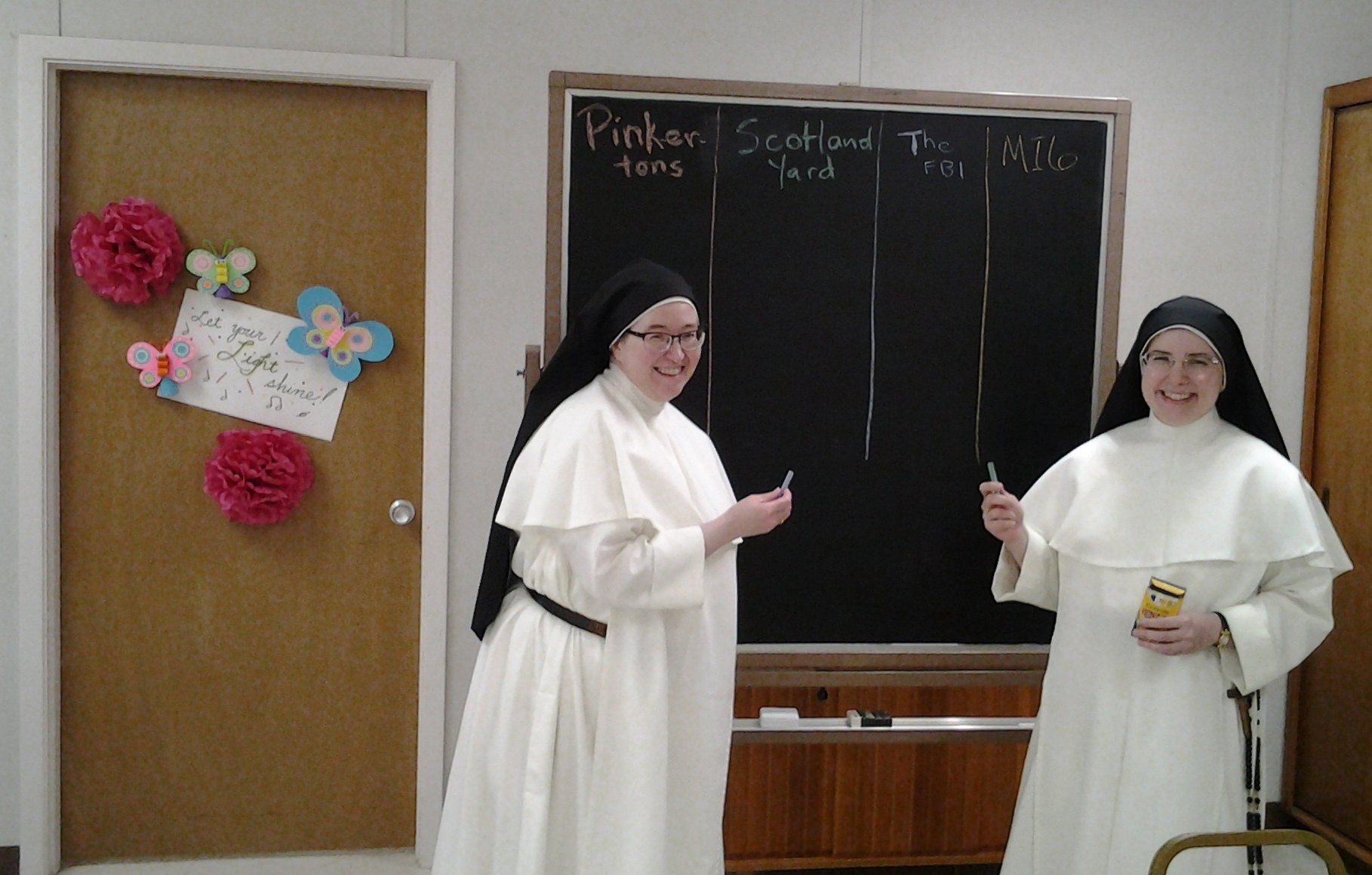
We spent the rest of the morning playing “Domingo”, which is, of course, “Bingo” with a Dominican theme. Instead of numbers, we have names of saints, important places, writings, things like that.
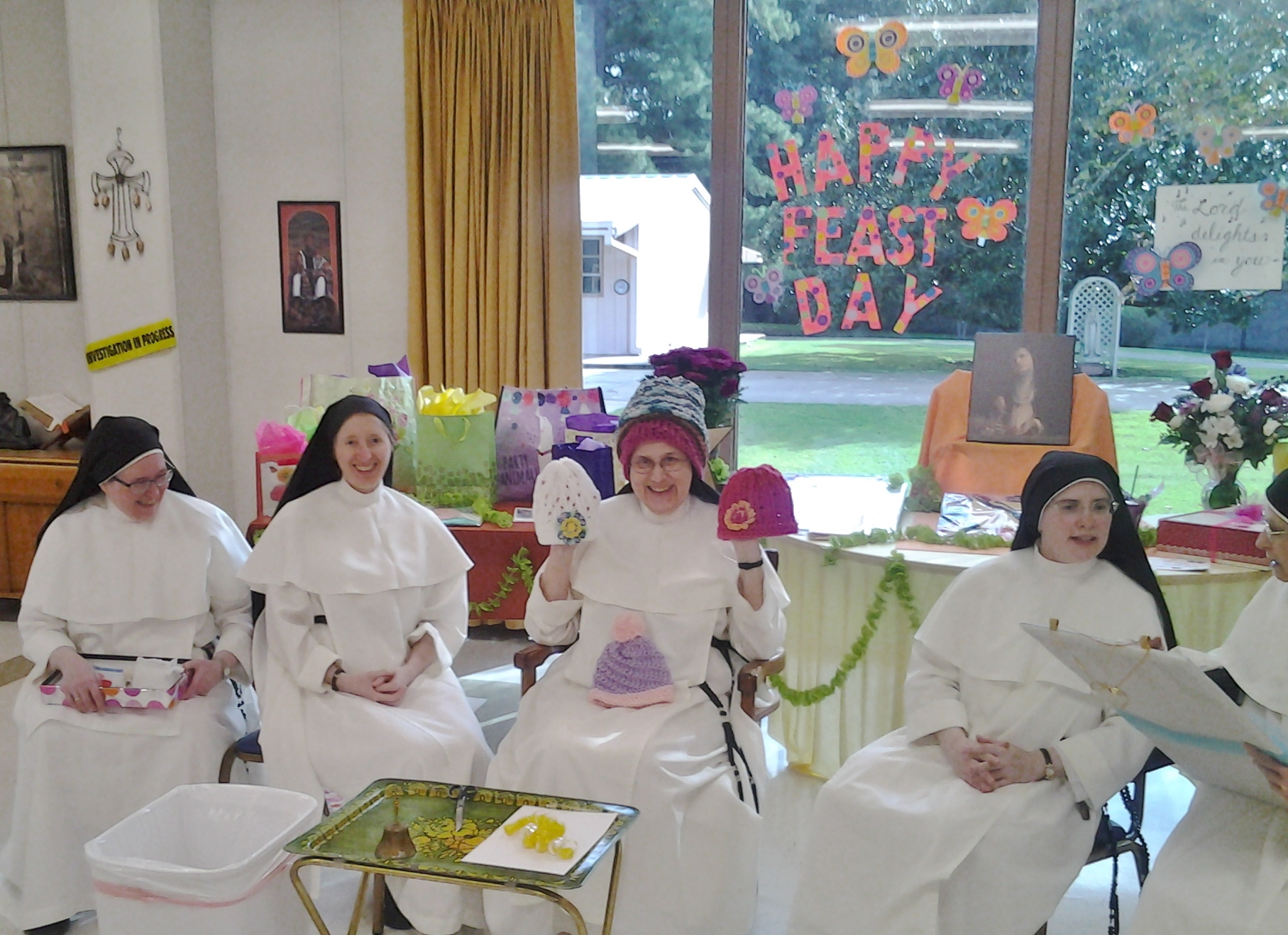
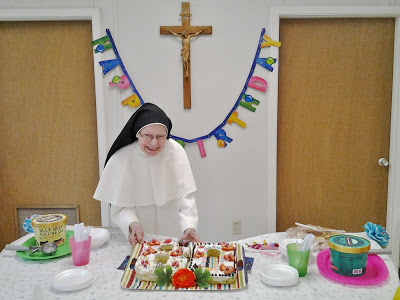
The sisters who organized the feast day this year thought up a unique–and welcome–prize. Instead of more “things”, we got the gift of time! Every winner (and fortunately, we all won in the end) received a Golden Ticket. This provides her with one full day of freedom to do whatever she wants to (within reason). The other sisters will even take her duties for her! No wonder Sister looks pleased in this picture.
We all had a long siesta time, and came back in the afternoon for a milkshake treat. Finally, we ended our great day with a movie, enjoyed by all.
Truly, how good and how pleasant it is when sisters live in unity!

Remembering Sister Mary Sybillina

Sister Mary Sybillina was a special person in so many ways. She was the last of our founding sisters who came to Lufkin from the Monastery of the Blessed Sacrament in Detroit (now in Farmington Hills, MI). She was a hard worker and kept most of her jobs until she was around 90! She had a great sense of humor, often making us laugh with her dry witticisms and quirky jokes.

So, we present here a retrospective of Sr. Mary Sybillina in photographs.

Sister as a postulant, 1945
Sister in a relaxed moment on the porch at the “old house” (first monastery building right on Lotus Lane–our present monastery is “up the hill” via an access road).


Sister Mary Sybillina at work in the laundry. We still use this extractor! (They don’t make them like the used to…)
Sister was a great reader! In addition to the local newspaper, she never missed reading L\’Osservatore Romano (news from the Vatican) and Origins (Church news and transcripts of talks by various people). She read all kinds of books, too.
Sister was an avid canasta player, almost right up until she died. No one who ever played canasta with Sister could accuse her of mental decline!
Celebrating her Golden Jubilee of Profession
One of the last pictures of Sister Mary Sybillina, seen here relaxing on the infirmary deck with Sister Mary Veronica.

Eternal rest grant to her, O Lord,and let perpetual light shine upon her. May her soul, and the souls of all the faithful departed, through the mercy of God, rest in peace.

The (New) Rugged Cross

                                                                                                                                                                        Like most nuns in monasteries all over the world, we have a lot of crucifixes around the place. For us, this is a beautiful remembrance of the love Jesus has for each one of us, even to His surrender to death on a cross for our sake. Although we put up these signs of Christ’s death, they are at the same time a reminder of His resurrection and His glory.
For many years, we had this plain wooden crucifix in our refectory. It was large enough that it could be seen easily by everyone in our big refectory, and it was poignant without being too gory. But this year, a little before Easter, we received a surprise gift:
A kind benefactor gave us this lovely new crucifix! The cross is handmade and hand-carved, and the person who made the cross bought an appropriate corpus to make the cross into a crucifix. This one is slightly larger than the old one, and definitely more eye-catching and colorful.
While it may seem strange at first to have a cross carved so beautifully, even this small attention to detail reminds us of the inherent beauty and majesty of Christ’s self-offering on the Cross. We are very thankful to have this in our refectory, where we can meditate on our Lord\’s Passion while we eat our meals. (Nuns do things like this!)
Ave Crux, Spes Unica!
Hail, Cross, the Hope of All!