Groundhog Day

Today, the feast of the Presentation, used to mark the official end of the Christmas season–that was before the liturgical changes after Vatican II, we believe. Some of our sisters here can remember leaving the Christmas decorations up until February 2–wow! February 2 is also known in the secular world as Groundhog Day, the day when groundhogs (or other rodent-like animals) are supposed to predict either the coming of spring, or six more weeks of winter. Believe it or not, this has a certain Christian angle to it–and we don\’t mean the use of the film \”Groundhog Day\” to help discern a vocation! As we celebrate today\’s feast, we begin to make a remote preparation for the season of Lent–which will begin in about a month (March 5, to be exact). Regardless of what the groundhog predicts, the seasons are gradually beginning to change from winter to spring, as we see the nights becoming shorter and the days longer. We put away the infancy narratives of Christ for another year; we focus anew on his public ministry and soon on his passion.
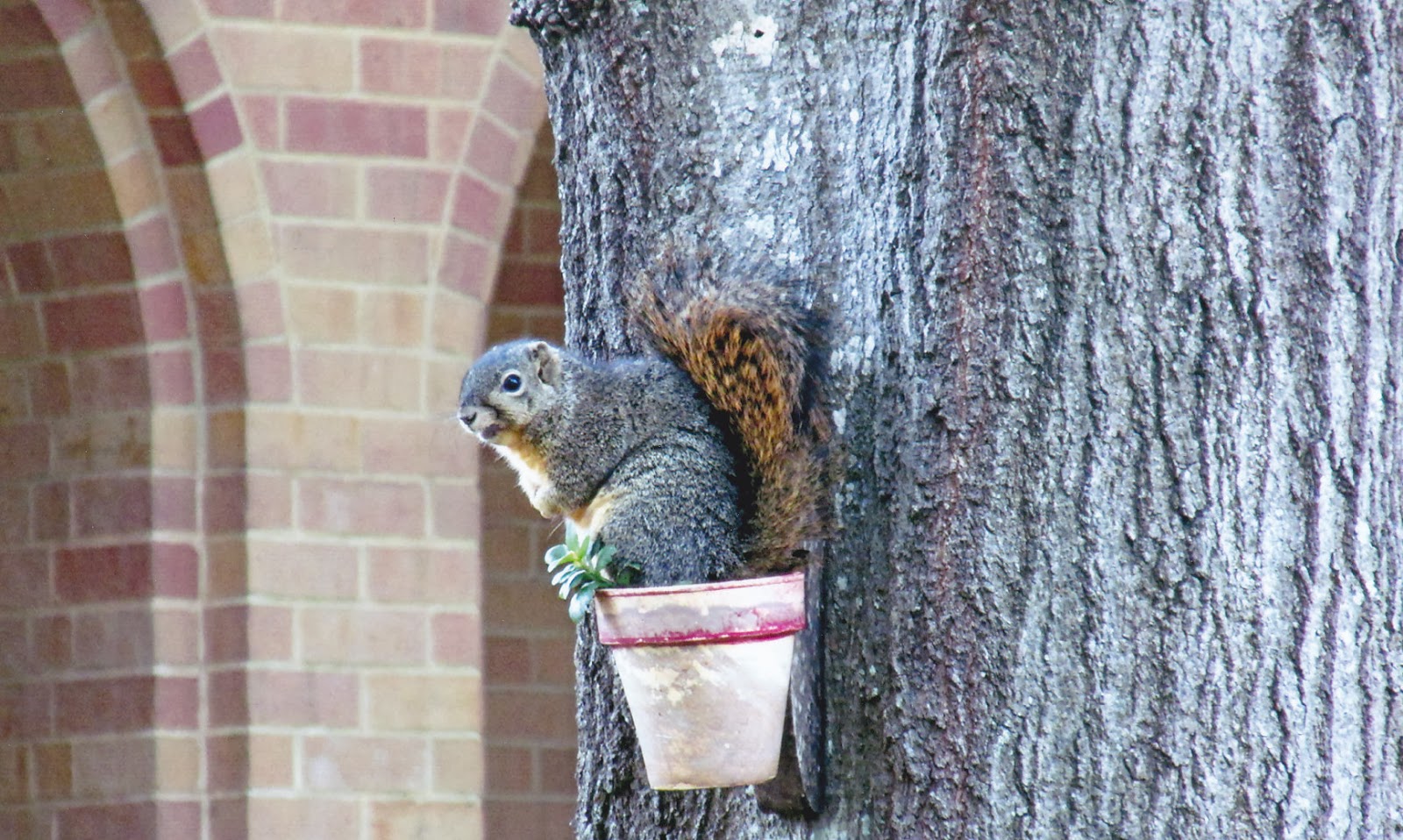
We don\’t have groundhogs in Lufkin–at least, not that we know of. We have lots of other native creatures, but if we do have groundhogs they\’ve never ventured onto the monastery grounds. So when we want to know whether spring is coming, or six more weeks of winter, we consult the squirrels!
Looks like this squirrel is expecting spring to come!!

Feast of the Presentation of the Lord, Part 2

The feast of the Presentation of the Lord is celebrated beautifully at the Monastery, with light, joyful songs, and a procession inside the cloister from the chapter hall to the main chapel. Each nun carries a candle that has just been blessed by the priest. It is as if we were going with the Holy Family to Jerusalem to fulfill the prescriptions of the Law of Moses–the purification of the Mother and the presentation of her first-born Son, Jesus, in the temple where God is present. 
Mary is holy and pure, but she chose to submit herself to the Law, although she did not need to do so. Her actions show her obedience to the will of the Lord. Mary offered to God her first-born Son, the true \”Lamb of God\”. When Jesus is brought to the temple by his parents, Simeon was inspired by the Holy Spirit to recognize him as the true Savior of the world. He proclaimed Jesus as \”a light for revelation to the nations\”. He added that Jesus would be a \”sign of contradiction\” and that a sword will pierce his Mother\’s heart. The parents were astounded and awed when they heard the divine mystery and plan that God had generously revealed to them. 
Today we are invited to join the procession to welcome Jesus into our hearts. He is our true light and freedom, sent by God to save the world. With confidence in God\’s mercy and Christ\’s love, \”let us go to God\’s house\”, offering ourselves and those who are dear to us to the most gentle and loving Father.

Feast of the Presentation of the Lord, Part I

This feast has had many names over the past two thousand years. The Mosaic law required a ritual cleansing of a mother forty days after she bore a son. This rite consisted in offering one sacrifice as a sin offering and a second in thanksgiving for a safe delivery. Because Joseph and Mary were poor and could not afford an animal, they offered two turtledoves or pigeons.The dedication of the first born son was joined to this ritual of purification. 
The liturgical celebration of this feast began in Jerusalem in the 4th century with the title, \”the 40th day after Epiphany\”. From there it spread to Byzantium, where by the 6th century it was known as \”the meeting of Jesus and Mary with Simeon\”. In the 7th century the feast was celebrated in Rome as the \”Purification of Mary\”. Today, it is called the \”Presentation of the Lord\”.
The ceremonial ritual of presentation in the temple is also a form of consecration to God. On this feast in 2002, Blessed Pope John Paul II said in his homily at Mass, \”In today\’s feast…we celebrate the mystery of consecration: consecration of Christ, consecration of Mary, consecration of all who follow Jesus for love of the kingdom.\” All the baptized are in a sense \”consecrated\”–set apart by God to do some mission for him, although some are called to follow in a more radical way through profession of the evangelical counsels. But no matter how we live the consecration we have received, we have the consolation of supernatural help from Our Lord and his Mother, as Blessed John Paul II concluded in his homily, \”How comforting it is to know that Mary is beside us, as Mother and teacher, on our path of consecration!\”

Tet 2014

It\’s that time of year again–the Lunar New Year, or Tet as our Vietnamese sisters call it! We have come full circle this year–we began our community celebrations of Tet in 2002 (which was also the Year of the Horse) and now we are starting (so to speak) another 12-year cycle! Over the years our celebrations have varied but some things remain constant, like our traditional dance choreographed by Sr. Mary Christine. We\’ll let the pictures of the dance speak for themselves!
 After the dance the sisters enjoyed delicious Vietnamese treats and lucky money envelopes.
It was all so good! Many thanks to those who provided us with these treats!
Some of the sisters in our community who were born in the Year of the Horse: Sr. Mary Rose, Sr. Maria Guadalupe, and Sr. Mary Veronica
We played some fun games and in the end everyone received a little gift. It was truly a wonderful celebration and a great opportunity to learn more of our sisters\’ varied cultural traditions and grow in our mutual love in Christ. We look forward to next year! 
Sr. Bernadette Marie and Sr. Irma display their New Year gifts.

3rd Sunday in Ordinary Time, 2014

In our first reading from Isaiah we have the actual text from the prophet, which is not exactly as Matthew gives it to us in the Gospel. The prophecy ends on a very positive note: 
The people who walked in darkness
have seen a great light;…
[God has] brought them abundant joy..
For the yoke that burdened them,…
you have smashed, as on the day of Midian. (Isaiah 9:1-3)
What is this \”day of Midian\”? Midian was a great and powerful nation southeast of Israel. For many years it had periodically plundered and raided the Israelites. This was the moment when Gideon was made a judge to protect and defend God\’s people. Gideon raised an army of 10,000 warriors, but God thought that was too many and sent all but 300 home. Besides that, he did not allow those left to use any weapons. The Israelites would defeat their enemy with horns, empty clay jars and torches. 
God did not need 10,000 soldiers to destroy Midian. He didn\’t even need 300. They were only an example of how much their faith enabled God to act through them to overcome danger. The same holds true for each of us. In the many battles and struggles of life, often all we can really do is pray to God for his help. Pray for guidance–to know God\’s will–and strength, to do it and carry it to the end.
Nothing in this world is secure and lasting–no nation, no continent, not even the mighty stars. Only God and what he wills is lasting. One of the things God wills to last forever is us–and our immortal souls. What are we doing to make ourselves ready for eternity? Each of our daily choices goes into the \”mix\” of our eternity. May our sins and tendencies toward evil \”be smashed as on the day of Midian\”.

Snow on Lotus Lane

As we finished Compline last night, it started snowing…and this morning we awoke to a rare (for Lufkin) winter wonderland! We haven\’t had a snow like this since…2010?? And this was heavier snow than we had back then!

Snow on the magnolia tree–and on Our Lady!
 In the woods
Another shot of the woods. You can see the novitiate building at the left.
The snow-covered angel at our flagpole.
By noon, the snow was beginning to melt, although it was still pretty cold outside–for Lufkin. We realize for many parts of the United States and some parts of the world snow is no big deal because it happens every winter, or at least more often than not. But for us it was an opportunity to wonder anew at God\’s marvelous works. And maybe to throw a snowball or two! \”Bless the Lord, ice and snow, praise and glorify him forever!\” (Daniel 3:70)

2nd Sunday in Ordinary Time, 2014

Last week we celebrated the feast of the Lord\’s baptism. Today God\’s word invites us to understand Jesus better through the preaching of John the Baptist, \”Behold, the Lamb of God, who takes away the sin of the world…\” (John 1:29). Why did John the Baptist call Christ a lamb? Let\’s examine two reasons. 
First of all, in the old law, there are several animals which can be offered to make reparation for sin: the heifer, the goat, the sheep (which might be a ram or a lamb), the turtle dove, and the pigeon. All of these prefigured the true sacrifice, which is Christ, who takes on himself the sins of the people and offers himself as a \”lamb of expiation\” (cf. Leviticus 14). 
Secondly, in the new and eternal covenant, Christ is sacrificed and offers himself. The Passover feast has a deep meaning in Israel\’s history. In Exodus 12 we read, \”Tell the whole congregation of Israel that on the tenth of this month they are to take a lamb for each family, a lamb for each household…it must be a lamb without blemish.\” It must be \”without blemish\” because it is an offering to God. This prefigures Christ who was pure, innocent, and slain. In Exodus 12:11, the meal is a necessary part of the ritual. When the Israelites came to the promised land, they continued to celebrate the Passover meal. It was seen as part of a sacrifice ritual, a covenant-making ritual. Our Lord chose the context of the Passover supper to institute the Eucharist. He says, \”This is my body…this is my blood, the blood of the covenant, poured out for many.\” (Mark 14:23-24)
In today\’s Gospel we are invited to participate in the offering of Christ which makes possible the living of the covenant. With God\’s help we come back to Christ in the Mass to renew the links that bind us to God and to receive grace and virtue from Christ\’s sacrifice in the Mass. As we read in Matthew, this \”blood of the covenant\” is \”poured out for many for the forgiveness of sins.\” (Matthew 26:28)