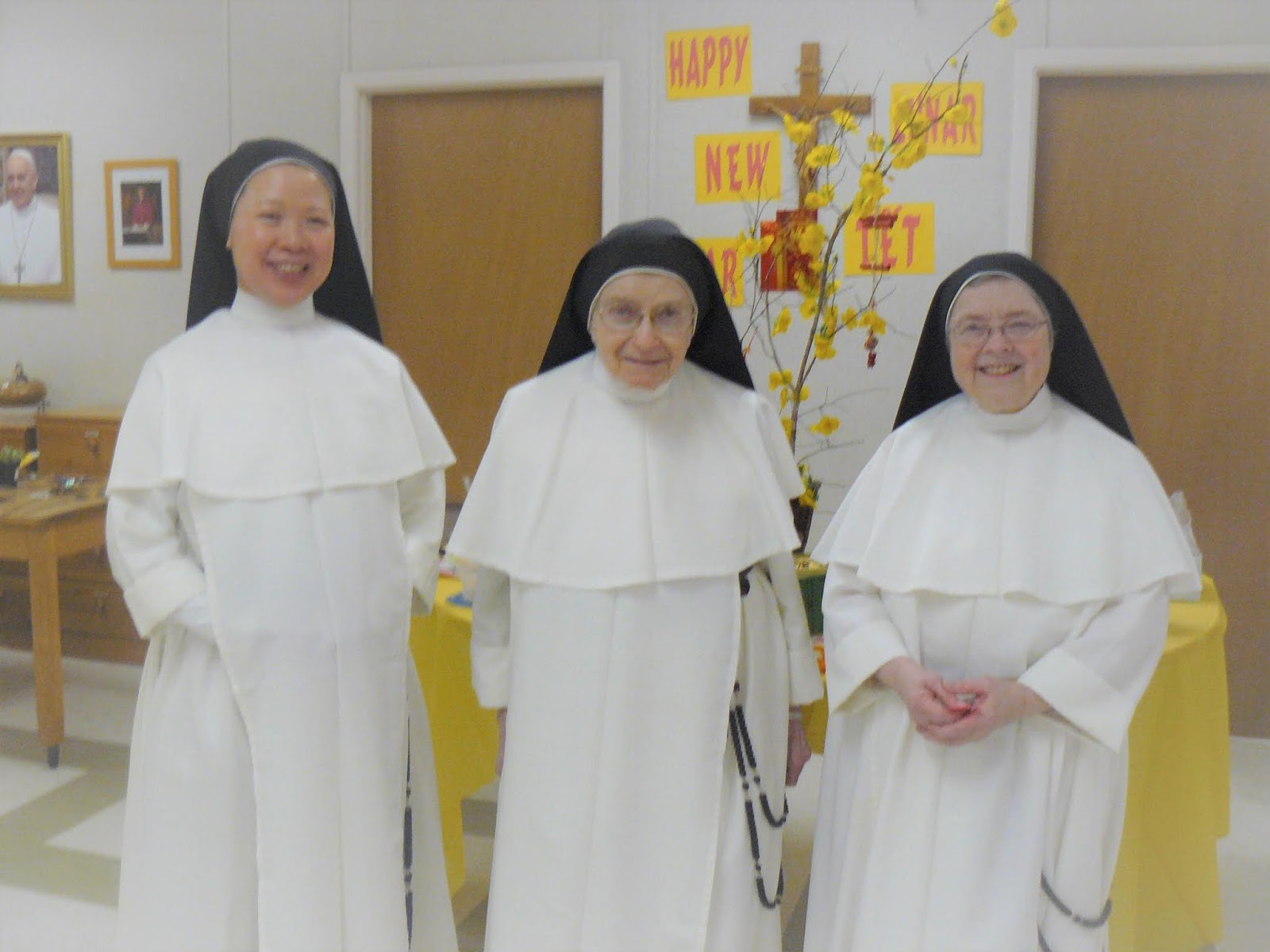
Tet 2020 — The Year of the Rat

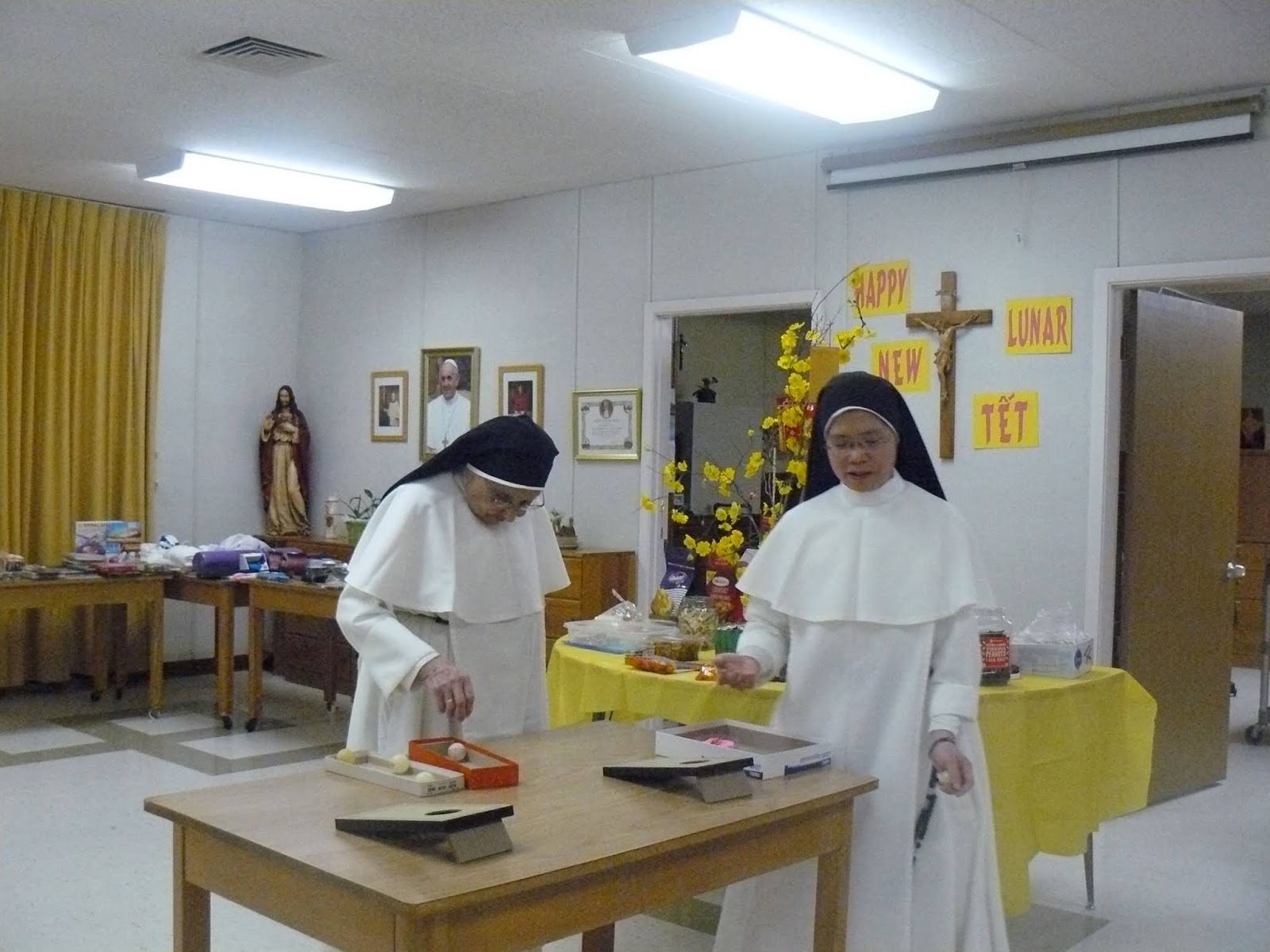
Every year we enjoy celebrating Tet, the Vietnamese variation on the Lunar New Year. It\’s an occasion for our community to be together in a fun way, celebrating the cultural backgrounds of two of our sisters and giving thanks for a New Year all over again. And, it does involve Vietnamese food, which makes it all the better! 
 
According to tradition, we play several games created by Sr. Mary Christine. Sometimes they are incredibly easy…and sometimes not. This was a year for “not easy”.
Sr. Mary Thomas trying in vain to get her rat (ping-pong ball) into its hole
Sr. Mary Veronica feels more confident

We have three sisters who were born in the Year of the Rat: Sr. Miriam, Sr. Mary Jeremiah, and Sr. Mary Giuse.

From L to R: Sr. Mary Giuse, Sr. Miriam, Sr. Mary Jeremiah
We wish all of you a Blessed New Year and pray it will be happy, healthy, and holy!

Something new…

Recently, it\’s come to our attention that although we\’ve made numerous changes to our website over the years (and wait, more are coming!) we really haven\’t done anything much with this blog. So, this being January, the beginning of a new year and a new decade, we decided to try something new.Cloistered nuns don\’t always appreciate new things, tending to stick with the good old adage, “If it isn’t broken, don’t fix it.” On the other hand, there are times when you need to step out of your old comfort zone and try something different, take a little risk. We like this new look, and hope you will, too.

If you are baffled because you can\’t find the old sidebars, never fear. They are still there! Just click on the gray triple horizontal bars in the upper left hand corner and those sidebars will slide right out.

Keep checking back here for more updates! We will post more news, spiritual musings, and let you know how the new website is progressing.

Special thanks to all who have encouraged us to keep moving forward on this project, especially our friends, family, and our Dominican brothers! We keep all of you in our prayers.

A Pig at the Airport

Two of our Sisters had to make a trip to California with a lay-over in San Francisco in mid-December. It turned out to be very memorable. While they were waiting for their connecting flight a crowd gathered taking pictures of someone or something. When the center of attention approached our Sisters, they saw the subject of attention and were immediately interviewed by a reporter from the local NBC TV station.

A week later they received a few telephone calls and emails about being seen on the national TV evening news. Below is the video and after it you can see a few screen shots. Enjoy.

A New Year’s Day Tradition

Every year on January 1, we gather about 10:30 am to draw our special patrons and intentions for the year. The ceremony begins with a Sister standing in the middle of the gathering and singing an ancient chant for the Nativity of Christ. Then, after everyone sits, the Prioress gives a talk. This year Sister Mary Margaret gave a very meaningful reflection of the meaning of the name, “Emmanuel”.

Afterwards, the two “youngest” Sisters distribute special prayer cards made for the occasion. Each Monastery seems to have this tradition, but it is done in slightly different ways. For example, one monastery may have one Patron for the entire community, while here in Lufkin, each Sister has a Patron and intention.

Each Sister receives a special title of Jesus or Mary, plus another saint, such as St. Joseph or a Dominican saint. Then we usually have a beautiful quotation upon which we can mediate throughout the year. Finally, at the bottom of the card is an intention for which each Sister pray during the year. Of course, on the front is always a lovely image and quote. Below you can see a sample of our card for 2020.

 
We then take turns reading our patrons, message and prayer intention.
left to right: Sister Mary Gabriel; Sister Mary Christine; Sister Marie Augustine; Sister Irma Marie sharing their cards
The ceremony itself concludes with singing Psalm 117: “Praise the Lord, all you nations…” and the Sister who leads the prayers that week says the closing prayer.
The remainder of the time is spent wishing each other a “Happy New Year.”
And, may you, our loyal reader, have a
VERY HAPPY NEAR YEAR IN 2020!

A Surprising Santa Sighting!

On Christmas Eve we hand a surprise visit from Santa and another person – either Mrs. Santa or an Elf. He called her his wife, while everyone else said she was an elf, Santa\’s helper. You can judge for yourselves. Maybe it’s not either/or, but both/and…

In the background you can see that our chaplain, Fr. John, came to join in with the festivities. Also present was a friend of “Mrs. Elf”.

They went right to work, not wasting a moment in handing out gifts to everyone. Three of the Sisters received special gifts: the prioress, the cook, and the Bursar, or treasurer. Unfortunately, the prioress, received a handful of coal!!!

But, don\’t worry, it was just chocolate candy wrapped in black paper.

We were able to snatch of photo to show that he really did come. Above, Santa is pictured, from left to right, with: Sr. Mary Thomas, Sr. Mary Rose, Sr. Mary Margaret, and Sr. Maria Guadalupe.

Merry Christmas to all!

Solemn Christmas Chapter 2019

The photograph below from our Chapel this morning is a summary our our entire Salvation History. From this angle, one can see God\’s Great Mysteries –  –  –
  • Our Lady stands in the middle radiantly white as the Annunciation
  • the four candles surrounding Mary on the Advent wreath represent the longing, yearning and anticipation for the coming of a Savior
  • the garland that crosses horizontally across the entire scene and unites all the images demonstrates that we are ready to celebrate the Birth of Jesus
  • the Crucifix on the right reminds us of the price Our Lord paid for our salvation, hope and peace
  • the monstrance in the background shows us the Risen and Glorified Lord of the entire universe
  • Emmanuel = God with us!
This morning, in the last hours of Advent, the nuns gathered in the Community Room because the new cooling and heating system has not yet been connected in our Chapter Hall. We met for our annual Solemn Chapter to reflect upon the great mystery of the Incarnation. after the chanting of the ancient martyrology by one of the Sisters, another gave a reflection on an ancient Advent hymn, Drop down dew from above.          Below is that reflection.
Solemn Chapter 2019
This morning, December 24, we are still in the Season of Advent, awaiting the mystical coming of Jesus Christ into our suffering world. I would like to reflect briefly upon the ancient hymn, Rorate caeli, Drop down dew…
Rorate coeli desuper et nubes pluant justum
Drop down dew, ye heavens, from above, and let the clouds rain the just
And the response:
Aperiatur terra et germinet salvatorem
Let the earth be opened and send forth a Savior.
This verse from Isaiah 45:8 in the Vulgate, is a very familiar refrain during Advent, leading into Christmas. The text is used frequently both at Mass and in the Divine Officeduring Advent, as it gives exquisite poetical expression to the longings of Patriarchs and Prophets, and symbolically of the Church, for the coming of the Messiah. If fact, just 2 days ago on the Fourth Sunday of Advent we used it three time in the Mass. During the Middle Ages it was called “The Advent Prose.”
In 1910, it was translated very beautifully by W. Rooke-Ley for the Scottish Book of Hymns, as:
Mystic dew from heaven
Unto earth is given:
Break, O earth, a Savior yield—
Fairest flower of the field. 
 The verses of this hymn give expression to profound human longings and sentiments of sorrow, penitence, expectation and comfort.
In the literal sense, we could say that the first verse is an admission of helplessness and need for God. It bemoans the destruction of Jerusalem and the Temple by the Babylonians. The “city of the Holy One” is laid waste, because of the sins of God’s people. This is punishment for their sins.
The second verse is a further confirmation of guilt. Sin has made the people lifeless like a dried leaf falling to the ground and being swiftly swept away by the unseen wind. It is not that God has broken them, but “the weight of our own sinning” has done it.
While the first two verses express the devastation of Jerusalem, the third verse begins to focus more on God and His compassion. We hear the people’s longing for the “Lamb who rules all earthly kingdoms.” But what is the reference: from Petra in the desert, to the mountain of the daughter of Sion?”
Do you have any insights? If I remember correctly, Fr. Dwight Longnecker in his book last year on the Mystery of the Wise Men, wrote that Petra might have been the region of the Magi. This would be a connection between the Nativity and the Passion. That is Petra refers to Christ’s birth and Sion to His death.
In verse four, we hear the beautiful words of Isaiah of YHWH and His plans to comfort His people. God will send them healing/ salvation “most speedily”, through himself / His Son, the people’s “sole redeemer”.
When God speaks, His words are meant not only for one period of time, but for all times and all peoples who will listen to them. To look into the spiritual meaning of these verses, we could say that society and religion are collapsing all around us. What are we to do, we who live lives hidden from the world?. Our Church is not meant to be a museum, but a living reality, the Bride of Christ. Each person is a “living” cell of Christ’s Body.
In verse 2: We reflect that the sins and failings of the leaders and members of the Church have cast Her low. Has the Father “hidden His face”? No, it is the ‘weight of our sinning” that is crumbling the needed structures.
In verse 3, we begin to recognize our need of a savior. After 2,000 years, are we no much better off than the first generation of Christians; no closer to the Coming of Christ’s Kingdom. And, yet, we yearn for the coming of the Lamb who will bring healing and forgiveness.
Yet, with verse 4, our hope bursts forth when we hear the Divine words of Comfort, God has not forsaken us. He will send us His Son. Let us be transformed not by sorrow, but by hope and joy. The Most Holy Trinity is our sole Redeemer Who will come to each believer in a more profound way this Christmas. Finally, we reflect briefly on the Refrain:
Rorate coeli desuper et nubes pluant justum
Drop down dew, ye heavens, from above, and let the clouds rain the just
And the response:
Aperiatur terra et germinet salvatorem
Let the earth be opened and send forth a Savior.
The church begs God to send down the waters of Grace which enable Justice, Salvation, the God-Man, to spring forth from the earth. These words cry out for a Savior Who is both Divine from above and Human from below—Whom we know as Jesus Christ our Lord. This verse prefigures the Incarnation, the uniting of Divinity and humanity, the spiritual and material, the Creator and the creature.
For a thousand years this verse from Isaiah has been the most popular description, or catchword, for Advent.
I wondered why. The thought came to me that for most of humanity’s history, society has been agricultural, and of course, this is still important for our physical survival. But since the 19thcentury, many people have become dependent upon others for their food. Those who farm, or garden, know the importance of rain for the “almost magical” mystery of growth and new life springing up from the soil. Rent seeds may fall into the earth, but it is rain – water- that makes them all germinate, each according to their own “kind”.
In this verse we have the divine showers coming down from the heavens to water the material earth so that we might have food to live. So too, god has dispensed His grace upon us to enable the seed of divine life within us to grow and reach maturity.
In the present time of crisis and confusion within the Church and the world, we must continue, and even re-double, our privileged and indispensable vocation of worship and intercession.
Without the contemplative life, the Church cannot survive. It is our hidden lives of prayer and sacrifice that call down the graces needed for others to respond to God’s call. Therefore, our lives should be one great cry to God:
Drop down dew, ye heavens, from above, and let the clouds rain the just
Let the earth be opened and send forth a Savior.
The Septuagint Book of Wisdom says, “A great number of wise persons will save the world.” Let us be those wise women who follow the Lamb, born in a stable, and spent His life for the salvation of all.

O Antiphon 2019 – O Emmanuel

The last of the great antiphons: O Emmanuel! Advent culminates all of Israel’s hopes, and the hope of all nations, in One who is to come, and who has come to us through Mary’s immaculate womb. There is often so little room in our hearts. But the Great Antiphons of this last week of Advent help us to prepare a place for Jesus Christ, so that He might lay upon the straw of all our desires.
Did Jesus comes as a baby like we all came into this world, because we are always children at heart?
The name “Emmanuel” means “God with us.” This antiphon reminds us of the incredible reality that our Supreme God and Creator truly did become man. The Second Person of the Holy Trinity – God the Son – became Incarnate because of His unconditional love for us and His desire to save us. Though difficult to fathom, the truth is that the Ruler of the Universe, the Alpha & Omega, the eternal God, united Himself to a human nature & entered this world in the most humbling way: as a babe in swaddling clothes. God as man was then cared for by His mother Mary. He required diaper changes & had to learn to walk & talk just like we do. God being with us, also allowed Himself to suffer as we do. At the end of his life, Jesus Christ freely accepted humiliation, the cruelest form of torture, abandonment by friends, the excruciating pain of crucifixion and death in order to redeem the world and bring salvation to us all. What an awesome reminder of the love God has for us and of how ever-grateful we should be for all God has done for us.

Faith gives joy. When God is not there, the world becomes desolate, & everything becomes boring, & everything is completely unsatisfactory. It’s easy to see today how a world empty of God is also increasingly consuming itself, how it has become a wholly joyless world. The great joy comes from the fact that there is this great love, & that is the essential message of faith. You are unswervingly loved. … Unbelief, too, is a heavy burden & in my opinion even more so than faith is. Faith makes man light. This can be seen in the Church Fathers, especially in monastic theology. To believe means we become like angels, they say. We can fly, because we no longer weigh so heavy in our own estimation.”  –Cardinal Joseph Ratzinger