Second Sunday of Lent

     Each Lent the Church encourages us to do three ancient practices: prayer, fasting and almsgiving/charity. 
     Today\’s Gospel, the Transfiguration, focuses us on prayer. The glorification of Jesus before his apostles is meant to strengthen them for his coming Passion and Death. Prayer will also strengthen and calm us in the midst of our own trials and difficulties. This Christ-moment can teach us much about prayer and contemplation. 
     Contemplation is a spiritual, intellectual and emotional experience in which the apostles (and we) can receive insight into the depths of both Jesus\’ humanity and divinity. It is a prayer that is given to us. We do not earn it or make it happen. God takes the initiative and we respond. 
     The Transfiguration presents contemplation as a growing and transformative experience for everyone involved–Christ, Moses and Elijah received greater glory, the disciples greater insight and understanding. We, too, struggle and gradually grow in prayer. The Spirit increases charity in our prayerful hearts. 
     The disciples had a process of training, climbing the mountain, waiting for the manifestation of Christ\’s glory. This Lent is an opportunity for us to grow in our awareness of being active members of the Body of Christ through our greater efforts at prayer.

St. Joseph

The bonds that exist between the heart of Joseph and that of the Child Jesus are–since Jesus is God–of an even more amazing clarity and strength. No child has ever been so united to his father as Jesus is to Joseph; no father has ever been so united to his child as Joseph is to Jesus. Joseph loves Jesus\’ heart–a heart so burning with love, so humble, so poor and so gentle; he loves it with a divine love, which is \”substantial\” and eternal. He is wholly given to Jesus and loves Him with all his heart as a man and as a father, and with all his sensibility, for Joseph loves the sensibility of Jesus\’ heart, which is so close to Mary\’s heart. 

–from The Mystery of Joseph by Fr. Marie-Dominique Philippe, O.P.

First Sunday of Lent

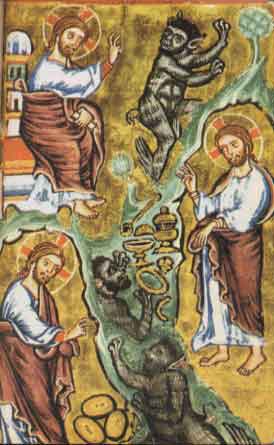
At that time Jesus was led by the Spirit into the desert to be tempted by the devil…
Matthew 4:1

The temptations Jesus faces in Matthew\’s Gospel are temptations to power and control in various guises. In fact, all our temptations seem to come down to this one thing: the desire to make ourselves like God. In union with our first parents, we have a hard time believing that God really forbade us to eat of the tree of the knowledge of good and evil (or whatever other sinful temptation presents itself to us). If we do not keep our gaze fixed on God alone, it\’s easy to be led astray by the apparent goods the devil offers us. But we can hold fast to God\’s Word, as Jesus did, quoting Deuteronomy to the devil in the desert and resisting the temptations to power and control that don\’t really exist. We know the devil can\’t deliver what he promises, so why listen to him? Let\’s keep our hearts open to God during this season of Lent and say with Jesus, \”Get away, Satan! It is written: The Lord, your God, shall you worship and him alone shall you serve.\” (Matthew 4:10)

Ash Wednesday

\”We are ambassadors for Christ, as if God were appealing through us. We implore you on behalf of Christ, be reconciled to God. For our sake he made him to be sin who did not know sin, so that we might become the righteousness of God in him. Working together, then, we appeal to you not to receive the grace of God in vain. For he says: In an acceptable time I heard you, and on the day of salvation I helped you. Behold, now is a very acceptable time; behold, now is the day of salvation.\” 
2 Corinthians 5:20-6:2
May this holy season of Lent bring us all closer to God! Amen!

Some Texas History from a Catholic Point of View

March 2 is the day Texas declared its independence from Mexico and so we are celebrating today! This is a special year for Texans because 2011 marks the terquasquicentennial of independence from Mexico–that\’s the 175th anniversary! What many people probably don\’t realize is that Texas was for centuries a Catholic area–\”discovered\” by the Spanish around 1519 and later a part of Mexico before winning independence in 1836. In their quest for gold and glory in the New World, the Spanish also brought priests to help spread the Gospel. Many of these missionaries in Texas were Franciscans who ministered to the Native Americans and built missions which are still standing today. Remember the Alamo? That was originally a Catholic mission in San Antonio!

The Spanish had help from a visionary Spanish nun, Maria de Agreda, who apparently bilocated to Texas in the 17th century and, while present, instructed the Jumanos (Native Americans in western Texas and eastern New Mexico) in the Catholic faith. Many of these Jumanos greeted the Spanish when they arrived and asked to baptized as a result of her work. 

 Maria de Agreda, who was a Poor Clare (Franciscan) nun

One of the most famous Native American converts in Texas is Angelina, a Caddo woman who learned Spanish and was invaluable for her intercultural skills, both as an interpreter and an adviser. The only county (out of 254!) in Texas to be named after a woman is Angelina County–coincidentally the county where our monastery is located!

 The statue of Angelina with a Native American and a Franciscan friar in Lufkin 
(Sculpture by Steve Gustafson)

There were many Catholics who fought for Texas independence. Some of the most famous were Jim Bowie, Ben Milam, and Erastus \”Deaf\” Smith. But the Catholic presence in Texas might have been lost if not for the work of dedicated bishops (like Bishop Jean Marie Odin, first bishop of Galveston) and the many diocesan and religious priests, religious brothers, and sisters who worked so hard to establish churches, schools, hospitals and orphanages in those early days–and the many faithful lay people who came as settlers, particularly Gil Y\’barbo (one of our sisters is a descendant of his!).  They not only kept the Catholic faith alive in Texas, but also paved the way for contemplative life in Texas, and we are glad to say there are several contemplative monasteries in Texas (including ours, founded in Lufkin in 1945).  The Catholic presence continues in Texas today and we are grateful for the contributions Catholics have made to our state throughout our history!  
A view of the front of our monastery–notice the bluebonnets, our state flower!

The Chair of St. Peter

The Chair of St. Peter refers to Peter\’s seat of authority in the Church. It is a feast of St. Peter and a feast of the Papacy itself, since the Pope is the successor of Peter. This feast has been celebrated since before the 4th century, and reminds us that the Bishop of Rome–the Pope–has jurisdiction over the Church throughout the whole world. St. Augustine wrote, \”Blessed be God, who deigned to exalt the Apostle Peter over the whole Church. It is most fitting that this foundation be honored since it is the means by which we may ascend to Heaven.\” And as Paul the Deacon writes, \” It is right for all the churches to honor Peter. As head of the Church, firm as the hardest rock, he confounded the enemies of Christ by the authority of the Holy Spirit, conquering by the strength of tireless endurance.\” We are glad to stand firm with Peter on this day and all days. We love our Pope! 

Tet at the Monastery

 
The Lunar New Year was officially celebrated on February 3, but for reasons too numerous to go into, we had our celebration last night! We had an excellent time…beginning at noon with homemade Vietnamese food for dinner and continuing with a special night recreation program organized by our sisters. It was an evening filled with fun and family spirit. 
 The treats and lucky money (hanging in red envelopes on the tree) were generously provided for us! Thank you so much!
It has become our custom to perform a Vietnamese dance as part of our Tet celebration. Congratulations and thanks to Sr. Mary Christine, who choreographed the dance and helped us learn it! You can see more of this dance on our website—www.lufkinnuns.org–on the Photos page.
Another part of our Tet celebration is playing games! This was a fun one–you had to toss a ping-pong ball into a vase filled with water. Sr. Mary Sybillina was an expert at this!
We wish all of you a very joyful Year of the Cat! May God bless you abundantly this year!